More adults than children now live with CHD
Fifty years ago, many children born with complex heart defects did not reach adulthood. Surgical and medical care has changed that so thoroughly that the population has flipped. According to the CDC’s heart defect data, about 1 million children and 1.4 million adults in the United States were living with a heart defect in 2010.
That success brings a new kind of responsibility. A repaired heart is not always a finished heart. Some repairs leave leaky valves, narrowed vessels or scar tissue that can trigger rhythm problems years later. Some children will need further procedures as adults. Many will need nothing more than regular checks for life.
The problem is that the checks often stop. A survey of young adults with CHD, supported by the CDC and published in The American Journal of Cardiology in 2023, found that about half had been lost to cardiology follow-up at some point, and more than 45 percent had gone over five years without seeing a cardiologist. Most of them were not unwell. They simply felt fine, had moved on, and lost the thread.
Why “I feel fine” is not the measure
Problems in adults with repaired CHD often build slowly. A valve can leak a little more each year. The right side of the heart can enlarge gradually after some repairs. A rhythm problem can begin as occasional palpitations that a young adult blames on coffee or exams.
Tetralogy of Fallot is a good example. Many children repaired in infancy do very well for years, but the pulmonary valve often leaks after repair, and a significant number eventually need it replaced in adolescence or adulthood. The timing of that replacement depends on scans showing how the right ventricle is coping, long before symptoms would make the decision obvious.
The person adjusts without noticing. Stairs take a bit more effort, sport becomes less appealing, sleep gets lighter. None of it feels like a heart symptom until a test shows otherwise.
Rhythm problems deserve their own mention. Scar tissue from childhood surgery can become the starting point for atrial flutter or other arrhythmias in the twenties and thirties. A young adult who notices a racing or irregular heartbeat should be assessed rather than reassured by a normal resting pulse, and in adult care that often means formal arrhythmia workups with prolonged monitoring.
This is why the schedule matters more than how someone feels on the day. An echocardiogram, an ECG, sometimes a cardiac MRI or exercise test, repeated at agreed intervals, picks up change while there is still time to plan around it. Our page on post-surgical follow-up plans describes how those intervals are set in childhood, and the same logic continues into adult care.
Transition is a process, not a referral letter
The handover from pediatric to adult care is sometimes treated as a single event: a final pediatric visit, a letter, a new name on a door. Clinical experience points the other way. It works best as a gradual shift that starts years earlier, often around age 12 to 14, and moves responsibility from parent to teenager in small steps.
In practice, that might look like a cardiologist speaking to the teenager first and the parent second. Then part of the appointment without the parent in the room. Then the teenager calling to book the next visit, ordering their own repeat prescription, carrying their own records.
For a teenager in Dubai juggling school, tutoring and sport, the practical side matters too. Booking routine scans during school breaks, keeping a shared calendar for appointments, and letting the teenager hold the reminder rather than the parent all build the habit before it is needed.
Parents sometimes find this harder than the teenager does. They have held the information for years, often through frightening times, and stepping back can feel like losing grip. It helps to see it as handing over a well-kept file rather than letting go. Our earlier post on talking about heart conditions with children covers the younger end of this same conversation.
What a teenager should be able to explain
By the time they leave school, a young person with CHD is in a much stronger position if they can tell a new doctor, without a parent present:
- The name of their heart condition and any operations or catheter procedures, with approximate dates
- The medicines they take, the doses, and what each one is for
- Whether they need antibiotics before certain dental work
- Which symptoms should prompt them to seek help quickly
- Any advice they have been given about sport, alcohol, smoking or vaping, and energy drinks
- Where their records and most recent scan reports are kept
None of this needs to be learned in one sitting. A cardiologist might ask a thirteen-year-old to name the condition, a fifteen-year-old to explain the medicines, and a seventeen-year-old to run the whole appointment. Each step is small. Taken together they produce a young adult who can speak for their own heart.
A one-page summary from the cardiologist, kept on a phone, covers most of this. Many families in Dubai and Abu Dhabi have children heading abroad for university, and that page travels with them to a new clinic in a new country.
Topics that come up for the first time
Adult care brings conversations that pediatric clinics rarely need to have. For young women with CHD, pregnancy planning is one of the most important. Many women with repaired heart defects have healthy pregnancies, but some conditions and some medicines carry real risk, and the time to discuss it is well before a pregnancy, not during one. Contraception choices also need a cardiologist’s input for certain conditions.
Infective endocarditis, an infection of the heart’s inner lining, becomes a more personal topic too. Good dental care matters more for some heart conditions than for others, and so do decisions about tattoos and piercings, which carry an infection risk that a cardiologist can put into proportion for a specific heart.
Career, driving, long-haul flights, high-altitude travel and competitive sport all have heart-related questions attached for some young adults. So does mental health: living with a lifelong condition, and the memory of childhood surgeries, can weigh on a person in ways that are worth naming and supporting. These are conversations best had with the young person directly, at an age when they can own the answers.
The first appointment on the other side
Adults with congenital heart disease are best served by cardiologists familiar with CHD, because a repaired heart behaves differently from a heart affected by the adult conditions most cardiologists treat. At KidsHeart, the pediatric team works alongside our Adult Cardiology service in Dubai, Abu Dhabi and Al Ain, so a young adult can move across without losing the history that explains their heart.
The handover usually includes a joint review of the full record: the original diagnosis, every procedure, the trend in scan results, and the plan for the next five to ten years. Where a young person needs a specialist adult congenital center, often abroad for complex cases, the team coordinates that referral.
The first visit in the adult clinic goes best when the young person arrives with their summary page, a list of current medicines, the dates of their last echo and ECG, and two or three questions of their own written down. Parents are welcome, and many come to the first one. Fewer come to the second.
The seventeen-year-old who could not name his operation does not need to become an expert. He needs to know enough to walk into a clinic in a new city and be taken seriously, and to understand why the yearly scan is worth keeping even in the years he feels perfectly well. For families with a teenager currently followed by our Dubai Healthcare City team, or by colleagues in Abu Dhabi and Al Ain, that conversation can start at the next routine visit, and the team can be reached ahead of it through the KidsHeart contact page.
Consultant, Fetal & Pediatric Cardiologist – American Board
Assistant professor, Columbia University, New York
Pediatric Cardiac Surgeon – American Board
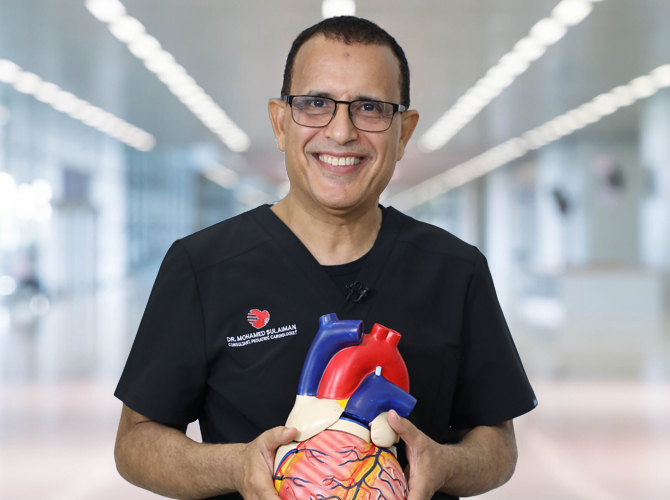
Dr. Mohamed Sulaiman

Dr. Emile A. Bacha