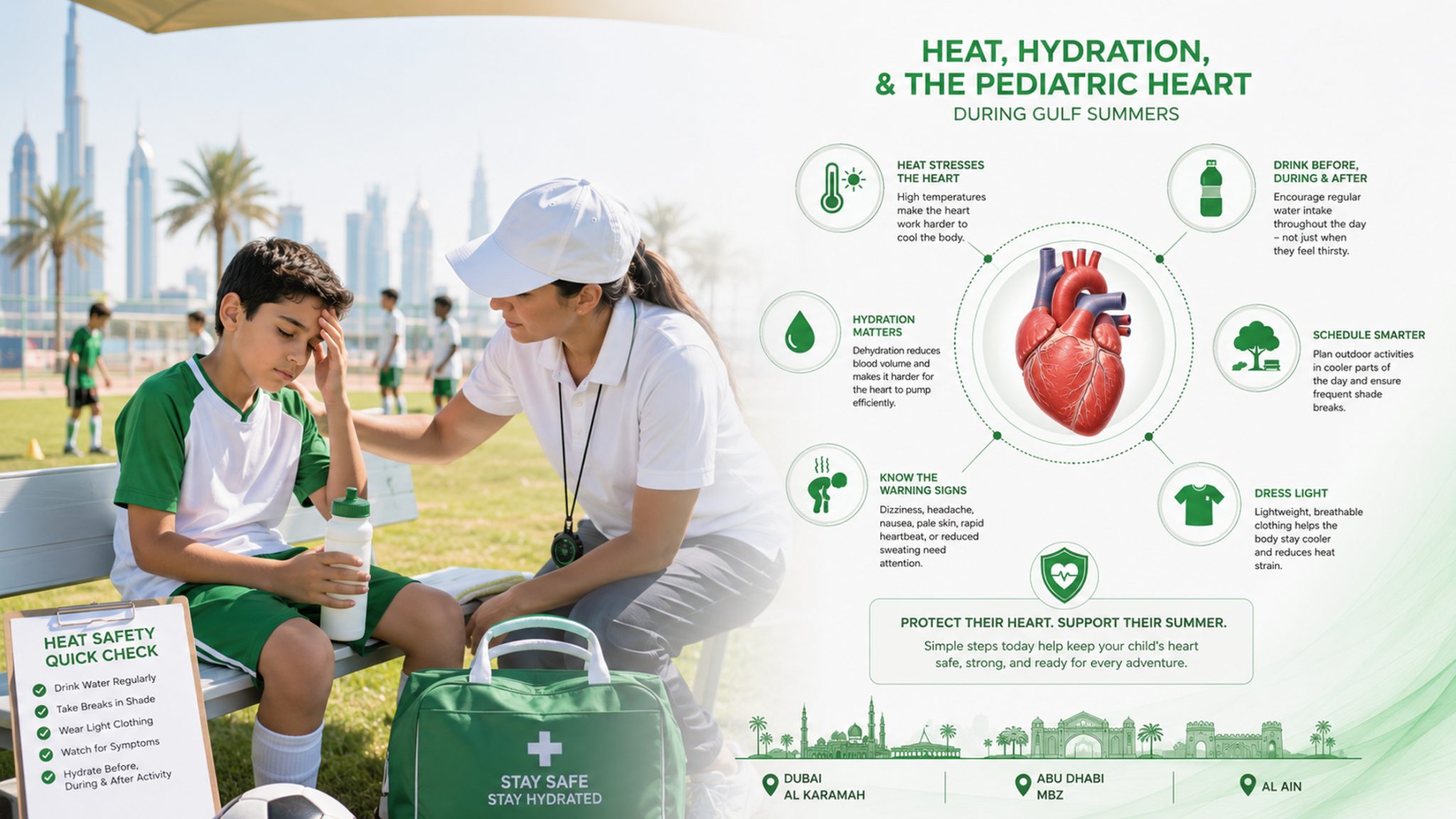
The pickup line at summer camp moves slower than usual today. When it’s finally your turn, the counselor walks your child over herself instead of waving him toward the car. “He sat out the last activity,” she says. “Seemed a little dizzy, wasn’t sweating as much as the other kids. He’s drinking water now and says he feels better.” He does look pale, and a little quieter than the version of him that left the house that morning.
Most days like this end exactly where they seem to be heading: a tired kid, a big glass of water, an early bedtime. Dehydration from summer activity is common enough that it rarely means anything more serious. It’s still worth understanding why a hot afternoon asks more of a child’s heart than the same activity would on a mild day, especially across a Dubai summer that regularly holds well above 40 degrees for months at a stretch.
The American Academy of Pediatrics, through HealthyChildren.org, notes that more than 9,000 U.S. high school athletes are treated for exertional heat illness every year, and that the majority of these cases cluster in August, right as the new season starts and bodies haven’t yet adjusted to the heat. That timing lines up almost exactly with when Dubai, Abu Dhabi, and Al Ain families are sending kids back into outdoor camps, practices, and school sports after the peak of summer.
Why Heat Puts Extra Load on a Child’s Heart
A child’s body cools itself the same basic way an adult’s does, by sweating and by sending more blood to the skin’s surface to release heat. That second part is the piece that matters for the heart. To cool the body down, the heart has to pump more blood, faster, to the skin, all while still supplying working muscles with oxygen. In serious heat, the heart is essentially running two demanding jobs at once.
Children take on more of this burden than adults doing the identical activity. A child’s body surface area is larger relative to body weight, which means faster heat gain from the environment, and children generally sweat less efficiently than adults until later in adolescence. The American Academy of Pediatrics puts it plainly: as body temperature climbs, a child’s heart can start to race as it struggles to keep pumping blood effectively throughout the body.
The Real Difference Dehydration Makes
Sweat is mostly water and salt drawn straight out of the bloodstream. Lose enough of it without replacing fluids, and blood volume itself drops. A heart working with less blood volume has to beat faster to move the same amount of oxygen around the body, which is exactly the racing, fluttery feeling a mildly dehydrated child sometimes describes, or simply looks flushed and unusually tired without being able to explain why.
This is a completely different mechanism from the cardiac conditions covered elsewhere on this blog, structural defects, inherited arrhythmias, and so on. Heat and dehydration create a temporary strain on an otherwise healthy heart. For the overwhelming majority of children, rehydrating and cooling down resolves it entirely within an hour, no lasting effect at all.
Children With an Existing Heart Condition Face a Different Calculus
For a child already being followed by a cardiologist, whether for a congenital defect, an arrhythmia, or a condition being monitored through KidsHeart’s Sports Participation & Heart Health program, heat isn’t just an added inconvenience. A heart that’s already compensating for a structural difference has less reserve capacity to also handle the extra demand heat places on it. That doesn’t mean these children need to sit out Dubai’s outdoor season entirely. It means the activity plan a cardiologist provides usually gets more specific about heat: shorter intervals, more frequent breaks, closer attention to how a child is doing rather than a blanket restriction.
Families in this situation, whether based in Dubai, Abu Dhabi, or Al Ain, benefit from raising the heat question directly with their cardiology team rather than guessing at what’s safe based on general summer advice meant for children without a heart condition.
Signs Worth Pulling a Child Off the Field For
Most heat-related symptoms resolve quickly with rest, shade, and water. A few are worth treating as a genuine stop-and-check moment rather than pushing through:
- Heart rate that stays noticeably elevated well after rest begins
- Confusion, unusual clumsiness, or slurred speech
- Skin that feels hot and dry rather than sweaty
- Vomiting or a headache that worsens rather than eases with water
- Fainting or near-fainting
These are the signs of heat exhaustion moving toward heat stroke, a medical emergency rather than ordinary summer fatigue. The gap between the two isn’t always obvious in the moment, which is exactly why a camp counselor pulling a child aside for a closer look, the way today’s did, is the right instinct rather than an overreaction.
Building Heat Safety Into a Dubai Summer
None of this means keeping kids indoors all summer, which brings its own tradeoffs. It means building a few habits into the season rather than treating hydration as an afterthought. Water before activity starts, not just once thirst kicks in. Regular breaks scheduled into practice and camp sessions rather than left to a child’s own judgment, since kids frequently don’t recognize thirst until they’re already behind on fluids. Lighter, looser clothing and, where possible, timing intense outdoor activity for early morning or evening hours rather than the middle of a Dubai Healthcare City-area afternoon in July or August.
KidsHeart’s Healthy Diet & Active Heart guidance, and a related piece the team has already written on building heart-healthy habits, both touch on the broader lifestyle side of this: hydration is one part of a heart-friendly routine that holds up across the calendar, not just during heat spikes.
Back in the Pickup Line
By the time you’re driving home, the color’s mostly back in his cheeks and he’s asking what’s for dinner, which is usually the reassuring sign it looks like. Most days like this end there. For families in Dubai, Abu Dhabi, and Al Ain navigating a genuinely hot climate with active kids, the goal isn’t to avoid the heat entirely. It’s knowing which signs deserve a second look, and having a cardiology team on hand for the ones that do, starting with booking an appointment at the Dubai clinic.