
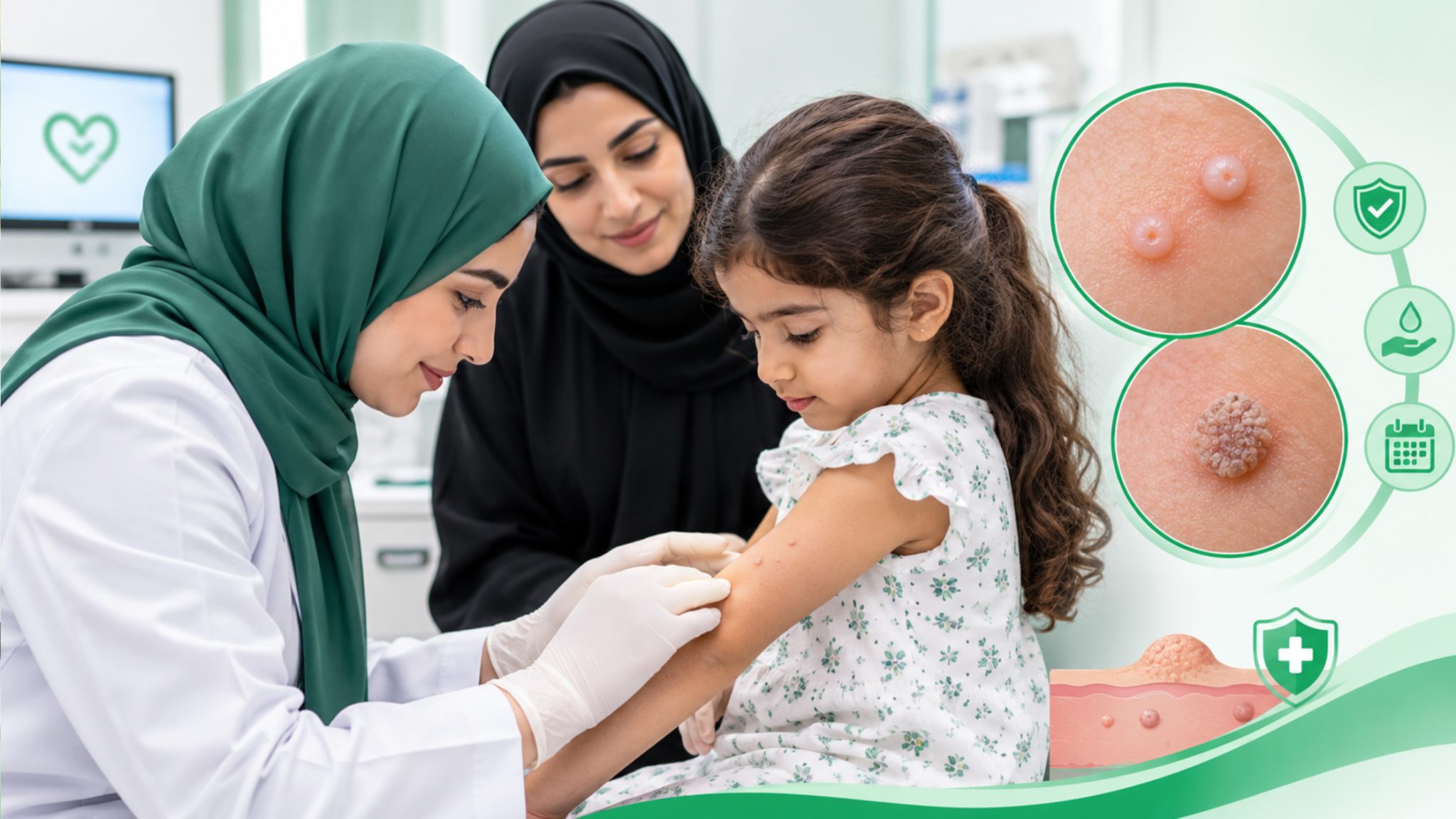
Two of the most common reasons a child sees a dermatologist have nothing to do with allergies, heat, or eczema. They are small bumps caused by viruses. Both spread from skin to skin, both tend to multiply before they disappear, and both usually go away without treatment if a family can wait long enough.
How long “long enough” is, and what to do in the meantime, depends on which one it is. The two look different once you know what to look for, and they behave differently too. This is a short field guide to each, written for parents trying to work out what is on their child’s skin before an appointment with KidsHeart’s Dermatology department at The Heart Medical Center in Al Ain.
Telling them apart at a glance
Run a finger over the bump. Molluscum is smooth and shiny, often with a small central dent. A wart is rough and grainy, like the surface of a cauliflower or a tiny sponge.
Look at where they are. Molluscum tends to appear in clusters on the body, the armpits, and skin folds. Warts favor the hands, the knees, and the soles of the feet, where skin takes the most knocks.
Count them over a few weeks. Both multiply, but molluscum often spreads faster, especially in a child who scratches.
Molluscum contagiosum
What it looks like: Small, smooth, dome-shaped bumps, usually skin-colored or pearly pink, often 2 to 5 millimeters across. Many have a tiny dimple in the center, which is the easiest way to recognize them. They are usually painless, though some itch.
Where it appears: Trunk, armpits, the inner elbows, behind the knees, and the thighs. In young children it often spreads into skin folds and areas that rub together.
Who gets it: According to the US Centers for Disease Control and Prevention, molluscum is most common in children between 1 and 10 years old. Children with eczema are more likely to get it and tend to get more bumps, because scratching broken skin spreads the virus.
How long it lasts: The CDC says the bumps typically go away in six months to a year, though they can take longer. Individual bumps come and go, so the total number may rise for months before it falls.
A sign that it is ending: Bumps sometimes turn red, swollen, and crusted, a little like a pimple. Parents often worry this is infection. More often it is the immune system finally recognizing the virus, and the bumps nearby tend to clear soon after. A bump that is hot, very painful, or oozing pus, or a child with a fever, does need a doctor to rule out a bacterial infection.
Some children also develop an itchy, eczema-like rash around the bumps, called molluscum dermatitis. Treating that rash with a gentle moisturizer or a short course of a prescribed cream reduces scratching, and less scratching means less spread. Bumps on or near the eyelids deserve a doctor’s look. Molluscum at the edge of the eyelid can cause a persistent red, irritated eye that does not clear until the bump itself is treated.
Children whose skin is already prone to flares may benefit from a look at their eczema care at the same visit.
Common warts
What they look like: Rough, raised, cauliflower-textured bumps, often with tiny black dots inside. The dots are small clotted blood vessels, not dirt or “seeds.”
Where they appear: Fingers, knuckles, around the nails, the backs of the hands, and the knees. Children who bite their nails or pick at the skin around them often have warts in exactly those places.
What causes them: Warts come from human papillomavirus (HPV), a large family of viruses. The types that cause hand warts are different from the ones linked with cervical cancer.
How long they last: Many warts in children disappear without treatment within a year or two. Some last longer, and a few keep spreading.
Why they come back: The virus can sit in nearby skin that looks perfectly normal. A wart can be removed cleanly and a new one appear beside it weeks later. That is not treatment failing so much as the virus showing up somewhere new, and the body usually clears it completely in time. Children with a weakened immune system, for example after a transplant or during certain treatments, can develop many warts that last longer, and their doctors should know about any new ones.
Plantar warts
What they look like: Flat, hard patches on the soles of the feet, pressed inward by body weight. They often look like a callus, with tiny black dots visible when the top layer is pared back. A cluster of small warts merging together is called a mosaic wart.
Why they matter: Plantar warts on the heel or ball of the foot can hurt, especially when walking or running. A child who starts avoiding sports or walking on the side of a foot may have one.
Where they come from: Pool decks, changing rooms, and shared showers. Swimming lessons are a common route, so flip-flops around the pool are a sensible habit.
Flat warts
What they look like: Small, smooth, slightly raised bumps, often in a line or a cluster, on the face, the backs of the hands, or the legs. They can be skin-colored or slightly brown, and there may be dozens.
Why they spread: Shaving and scratching move the virus along the skin, which is why flat warts sometimes appear in a neat row.
What actually speeds things along
For both conditions, the honest starting point is that treatment is optional in many children. The virus will usually clear without help. Treatment makes sense when the bumps are spreading fast, causing pain, itching, or infection, sitting on the face or in the genital area, or bothering the child.
For molluscum, options in a dermatology clinic include gently scraping the bumps away, freezing them, or applying a blistering liquid that makes them lift off over a few days. Each has trade-offs in comfort and scarring, which matters more on young children. The CDC advises against parents trying to remove the bumps themselves, since squeezing spreads the virus and can leave marks.
For warts, the usual first step at home is a salicylic acid preparation applied daily for several weeks or months, after soaking and gently filing the top layer. In clinic, cryotherapy with liquid nitrogen freezes the wart, usually over several visits. It stings, which can make it hard for small children. Stubborn warts sometimes need other treatments. More detail on what the clinic offers is on the warts and viral growths page.
Choosing to wait is a legitimate decision, not neglect. Many dermatologists recommend exactly that for a child with a handful of molluscum bumps that are not bothering anyone. A monthly photo of the same patch of skin, taken in the same light, shows whether things are improving and makes any later appointment more productive.
Any bumps or warts in the genital area should be looked at by a doctor rather than treated at home.
Living with it while it clears
Most children do not need to stay away from school, nursery, or swimming. A few practical habits keep spread down:
- Cover visible bumps with clothing or a bandage during contact sports and swimming
- Use the child’s own towel, and do not share flannels or bath toys with bumps on them
- Keep nails short and discourage picking or biting
- Treat any eczema around the bumps
- Wear flip-flops in pool areas and changing rooms
Siblings who share a bath often pass molluscum to each other. Bathing them separately for a few months is a simple fix. If a nursery or swimming school asks about the bumps, a short note from the doctor confirming the diagnosis usually settles the question.
The warm months in Al Ain bring more time in pools and less clothing, so new bumps often appear in spring and summer. The post on skin conditions in children covers other problems that tend to show up at the same time of year.
When to book a visit
A dermatologist is worth seeing when the diagnosis is unclear, when bumps are spreading quickly despite home care, when they are on the face, eyelids, or genital area, when a plantar wart is causing pain, or when a child is self-conscious and wants them gone. A dermatologist can also confirm that a bump is what it seems, since a few other skin conditions can look similar.
For families in Al Ain and nearby areas, the visit usually takes less time than parents expect. A quick look under good light is often enough for a diagnosis.
Most of these bumps will be gone by this time next year. The visit is about getting there with less spread and less scratching along the way. To arrange one at the Al Ain branch, contact KidsHeart and mention which kind of bump you think it is.