
A short circuit, not a weak heart
A normal heartbeat starts in a small cluster of cells at the top of the heart, travels down through a single junction to the lower chambers, and fades away until the next beat begins. It is a one-way trip.
In most children with SVT, there is an extra electrical pathway, present from birth, that lets the signal loop back up to the top of the heart and around again. Once that loop starts, it can keep going at 200 beats a minute or more, until something interrupts it. The heart muscle itself is usually completely normal. The problem lies in the wiring.
A specific form called Wolff-Parkinson-White (WPW) pattern shows up on a resting ECG as a characteristic change, even between episodes. Other forms leave no trace at all on a routine ECG, which is why a normal tracing does not rule SVT out.
The type also shifts with age. Pathways like the one in WPW are the usual cause in babies and young children. In teenagers, a loop inside the junction itself, called AV nodal reentrant tachycardia, becomes more common. The names matter mainly to the cardiologist planning treatment; to the child, an episode feels much the same.
According to the Children’s Hospital of Philadelphia, SVT is the most common heart rhythm problem found in children, occurring in somewhere between 1 in 250 and 1 in 1,000 of them.
How an episode looks at different ages
The defining features are the speed and the abruptness. The rate jumps rather than climbs, and when it stops, it stops at once rather than winding down the way a heart does after running.
What parents actually see depends on the child’s age:
- Infants: unusual pallor, fast breathing, poor feeding, irritability or sleepiness, and a chest that seems to flutter
- Toddlers: sudden clinginess, crying, or saying their tummy hurts, because they lack words for a heartbeat
- School-age children: “my heart is beeping,” “it’s going really fast,” or a pounding felt in the neck
- Teenagers: palpitations, a light-headed feeling, chest discomfort or shortness of breath, sometimes during sport
Older children often describe it precisely and can tell when an episode has begun. Babies cannot, so infant SVT is usually found because a caregiver notices the baby looks unwell, or because a doctor counts a heart rate of 250 or higher during an unrelated visit. A baby whose episode lasts many hours can become ill, which is why infant SVT is treated as an urgent matter.
Plenty of fast heartbeats in children are not SVT. A heart rate that climbs gradually with exercise, fever, excitement or fear, and settles gradually afterward, is a normal response. Our post on palpitations in kids covers those everyday causes and the signs that point toward a rhythm problem.
The pattern that raises concern is the abrupt one: a sudden jump to a very high rate, often at rest, ending just as suddenly. Fainting, chest pain or breathing difficulty during an episode, or an episode that does not stop, needs emergency care.
Getting the rhythm on record
The hardest part of diagnosing SVT is that episodes rarely happen in the clinic. A child who arrives in Dubai Healthcare City on a Tuesday afternoon may have a perfectly normal heart rate and a perfectly normal ECG.
So cardiologists work to capture an episode, or at least the evidence of one. The starting point is a resting electrocardiogram (ECG), which can show the WPW pattern if present. Our earlier post on the pediatric ECG explains the test itself.
When episodes are frequent, a Holter monitor records every beat for 24 to 72 hours. When they are rarer, an event monitor worn for weeks can be triggered by the child or parent when symptoms start. An echocardiogram is usually added to confirm the heart’s structure is normal, and an exercise test may be suggested if episodes tend to start during sport.
Parents can help in practical ways. A note of the date, time, what the child was doing, how long it lasted and how it ended is useful. A video showing the child during an episode, or a smartwatch screenshot of the rate, can be useful too, though consumer devices are not diagnostic tools on their own. An ECG taken during an episode at an emergency department is the most valuable record of all, so it is worth asking for a copy.
Treatment depends on frequency, age and the child’s own view
Not every child with SVT needs daily treatment. A school-age child who has one brief episode a year that stops on its own may simply be taught what to do and monitored.
Cardiologists often teach families vagal maneuvers, simple actions that can slow the electrical signal through the heart’s junction and break the loop. Which techniques suit a particular child, and when to use them, is something to learn directly from the cardiologist rather than from a video, because the right choice varies with age.
In an emergency department, a medicine called adenosine given through a vein usually stops an episode within seconds. It is effective, briefly unpleasant, and very short acting.
For children with frequent or prolonged episodes, daily medication can reduce how often SVT occurs. Infants are commonly treated with medication for the first year, since many outgrow the tendency.
For older children and teenagers, catheter ablation is an option that can offer a permanent cure. A thin catheter is guided to the heart through a vein, the extra pathway is located, and a small area of tissue is treated so it no longer conducts. Success rates are high, though as with any procedure, there are risks to discuss. The procedure is done at a specialist pediatric electrophysiology center, with the child’s own cardiologist coordinating the referral and the follow-up afterward. Our arrhythmia management page describes how these options are weighed.
Teenagers often have strong views of their own. Some would rather avoid a daily tablet; others would rather avoid a procedure. Both are reasonable starting points for the conversation.
School, sport and travel
Once SVT is diagnosed and a plan is in place, daily life usually changes very little. Most children with well-controlled SVT take part in PE and team sports. The cardiologist may suggest limits for some activities, particularly where an episode could be dangerous in itself, such as swimming alone or climbing, until the pattern of episodes is clear.
A short written plan helps the adults around the child. It typically covers what an episode looks like for this child, any technique the cardiologist has taught, how long to wait before seeking help, and which symptoms mean calling an ambulance. A copy for the school nurse, the sports coach and grandparents saves anyone having to guess.
Families from Dubai who travel often, whether home for the holidays or on long-haul trips, are usually advised to carry a copy of the child’s most recent ECG and a brief letter from the cardiologist. An emergency team abroad can act faster with a baseline tracing in hand.
After the diagnosis
The long view is usually reassuring. Many babies diagnosed in the first months stop having episodes by their first birthday, although some see them return later in childhood. Older children and teenagers are less likely to outgrow the tendency, which is one reason ablation is often discussed with them. Follow-up visits track how often episodes happen and whether the plan still fits the child as they grow.
Most children with SVT go on to play sport, travel, sit exams and grow up without the condition shaping their lives. Clear instructions help. So does knowing which hospital to go to and what to say when an episode does not stop.
Our cardiologists in Dubai, along with colleagues at the Abu Dhabi and Al Ain branches, see children across that whole range, from a single suspicious episode to a decision about ablation.
The girl on the sofa finished her book that evening. Her ECG the following week showed why the episode had started, and what could be done about it. When a child’s heart has raced and stopped in a way that did not look like ordinary exertion, the Dubai Healthcare City team can see them through our appointments page.
Consultant, Fetal & Pediatric Cardiologist – American Board
Assistant professor, Columbia University, New York
Pediatric Cardiac Surgeon – American Board
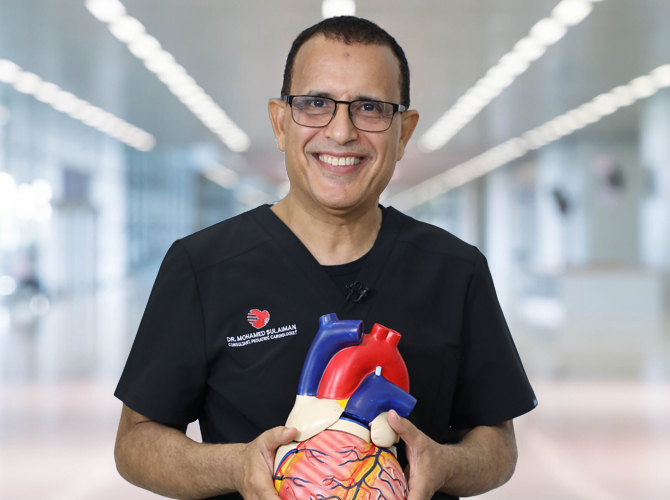
Dr. Mohamed Sulaiman

Dr. Emile A. Bacha