
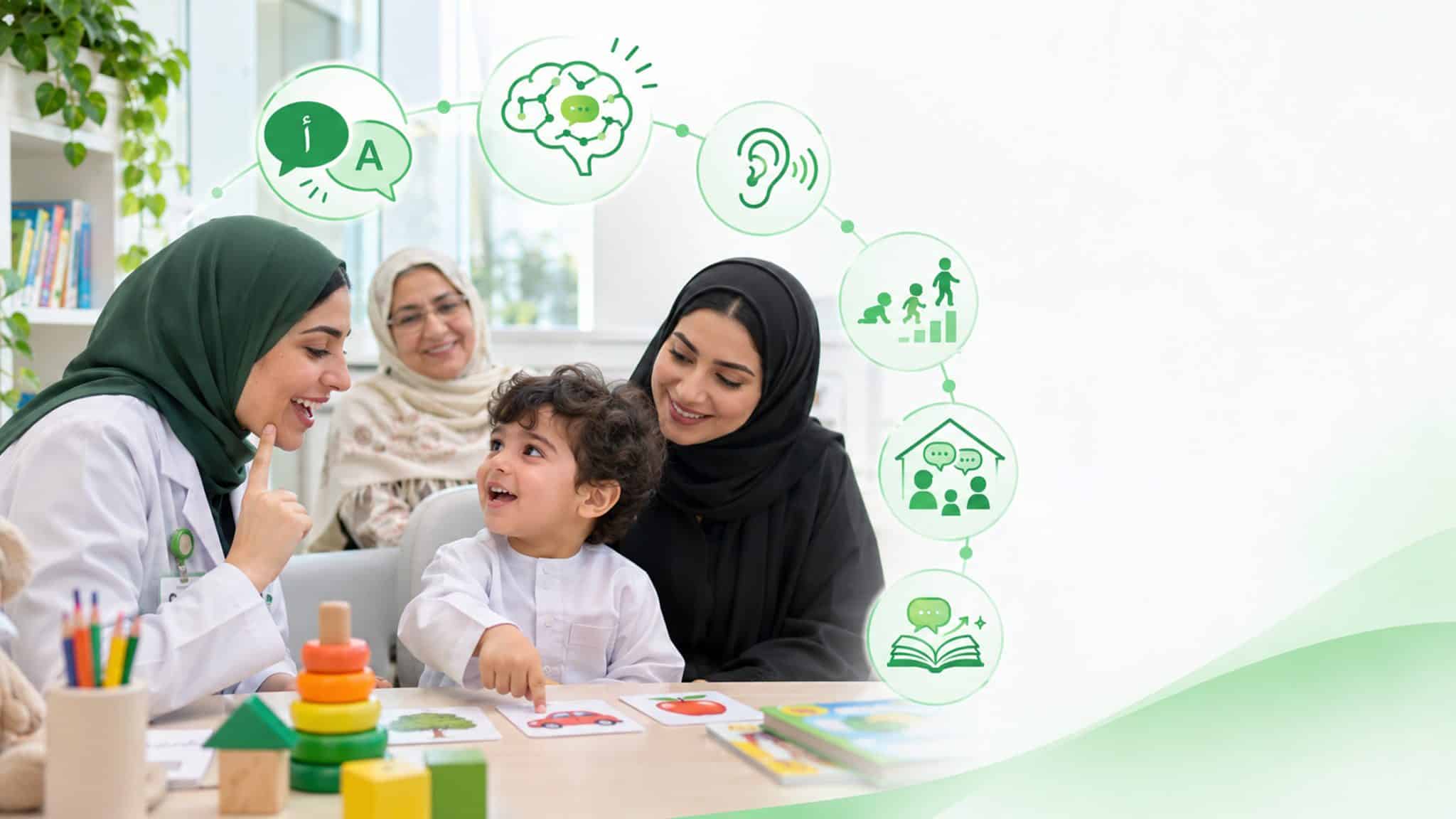
At home, he hears Arabic from his grandmother, Urdu from his mother and English from his father. At nursery, it is English all day, with a bit of Arabic in circle time. He is two and a half. He says “mama,” “baba,” “water,” “ma’a” and “no,” and points at nearly everything else. His cousin, the same age and raised in one language, chats in short sentences.
A relative suggests dropping a language “until he catches up.” Someone at the park says bilingual children always talk late. The pediatrician says to wait a few months. Each piece of advice pulls in a different direction, and the parents are left wondering whether the very thing they hoped would be a gift is holding him back.
It is one of the most common questions our Speech Therapy team hears at our Abu Dhabi branches in Al Karamah and MBZ, and at The Heart Medical Center in Al Ain. Many of the families we see raise children in two, three or even four languages, and the answer is reassuring in most cases and clear in the rest.
Bilingualism does not cause speech or language delay
This point is well established. The American Speech-Language-Hearing Association states plainly that learning more than one language does not cause or worsen speech or language problems, and that children learning several languages develop language skills just as other children do.
Multilingual childhoods are also far from unusual. In the United States alone, the Federal Interagency Forum on Child and Family Statistics reported that about 21 percent of school-age children spoke a language other than English at home in 2021. In the UAE, the share of children growing up with more than one language is far higher, and that diversity is part of everyday life in a nursery class in Abu Dhabi or a playground in Al Ain.
A child who is genuinely delayed in language will usually show it in every language they hear, not because there are two of them but because of an underlying difficulty that would have shown up in a single language too.
Some features of bilingual development can look like delay to an anxious eye, but are entirely typical.
Vocabulary is split. A child may know “water” in English and “ma’a” in Arabic, or know food words in one language and playground words in another. Count only one language and the child looks behind. Count both, and most bilingual toddlers have a total vocabulary in line with children their age. Speech therapists call this conceptual vocabulary: the number of ideas a child can name, in any language.
Mixing languages, sometimes called code-switching, is normal. A sentence that starts in English and finishes in Arabic is not confusion. It is a child using every word available to get a message across, which is exactly what adults do in multilingual homes.
A silent period can happen when a child starts nursery in a new language. Some children say very little in that language for a few weeks or even months, while understanding a great deal. They are listening. Speech in the home language should continue during this time.
Milestones arrive on a similar schedule. Bilingual children typically say first words around their first birthday and begin combining words around two, in whichever language is stronger.
Signs that point beyond bilingualism
Because bilingualism does not cause delay, the same warning signs apply as for any child, judged across all the languages a child hears. Signs worth discussing with a pediatrician or speech therapist include:
- Little babbling or few gestures, such as pointing or waving, by 12 months
- No single words in any language by around 16 months
- No two-word combinations in any language by 24 months
- Difficulty understanding simple instructions in the home language
- Speech that family members who share the language find hard to understand by age three
- Loss of words or skills the child previously had, at any age
The last point always deserves prompt attention. Loss of language is never explained by bilingualism.
It also helps to ask how the child communicates without words. A toddler who points to share interest, brings toys to show a parent, follows a gaze, and responds to their name is building the foundations of language, even if words are slow. A toddler who rarely does these things needs a fuller look. So does one whose understanding seems as limited as their speech, since comprehension usually runs well ahead of talking.
Our earlier post on spotting late talkers explains how speech therapists distinguish the two in more detail.
How a bilingual child is assessed
A fair assessment looks at all the child’s languages, not just the one the therapist speaks. Testing a bilingual child in English alone tends to underestimate what they can do, and can lead to children being labeled delayed when they are not, or missed when they are.
In practice, the speech therapist gathers a detailed language history: which languages the child hears, from whom, and for how many hours a day. Parents are asked to list words and phrases in each language, which builds the conceptual vocabulary picture. The therapist observes play and communication, and where possible assesses in more than one language, with family members helping to interpret responses in languages the therapist does not speak.
A hearing test is part of any language assessment. Fluid behind the eardrum from repeated ear infections is a common, treatable reason for delayed speech in toddlers, bilingual or not.
Our bilingual language support service is built around this kind of assessment, and around therapy that respects the family’s languages rather than replacing them.
If therapy is recommended for a toddler, it rarely looks like drills. Sessions are play-based, with the therapist modeling words during games, songs and snack time, and much of the work is coaching parents to do the same at home in their own language. For children under three, our early intervention for toddlers program is set up around exactly this kind of parent-led practice.
The advice to drop a language
Parents are still sometimes told to stop speaking their home language so a child can focus on English. Speech therapists now advise against this in almost every case.
A child’s home language connects them to grandparents, relatives and culture. Once it fades in early childhood, it can be hard to rebuild, and some families later find their children unable to hold a real conversation with the oldest generation. It is often the language in which parents are most fluent, most playful and most expressive, and that richness matters for language growth. Switching to a language a parent speaks less comfortably usually means the child hears fewer words, simpler sentences and less natural conversation.
Skills built in one language also carry into others. A child who understands how stories work, how questions are asked and how to take turns in conversation brings that knowledge to every language they learn.
When a child does have a language delay, therapy can support both languages. Parents learn strategies to use in their own language at home, and the therapist works on targets that transfer across languages. Our language delay page describes the approaches used.
What families can do now
Most families do not need a strict system such as one parent, one language. What matters more is that the child hears plenty of rich, natural language from people who speak it comfortably, every day.
Talk during routines, such as bath time, meals and car rides, in whichever language comes naturally. Read and tell stories in each language. Sing. Name what the child is looking at. When a child mixes languages, respond to the meaning and model the word back in the language being spoken, without correction.
Two everyday habits make a measurable difference. A television or tablet left playing in the background tends to reduce how much adults talk to children, even when no one is watching it closely. And short, frequent back-and-forth exchanges, a child babbles, the adult answers, the child responds, build language faster than long periods of adult talk directed at a quiet child.
Many households include a caregiver who speaks a further language, which is common in Abu Dhabi and Al Ain homes and not a problem in itself. The caregiver is best encouraged to speak the language they know well, with warmth and plenty of words, rather than a language they speak hesitantly.
And keep a simple record. A list of words in each language, updated every month or two, gives the pediatrician or speech therapist far better information than a general impression. The two-and-a-half-year-old from the opening may turn out to have 80 words across three languages, which is a very different picture from five words in English. If the list stays short, or the warning signs above appear, our speech therapists at Al Karamah, MBZ and Al Ain can assess all of a child’s languages together, and an evaluation can be booked through our appointments page.