Discharge day rarely goes exactly as planned. On day two of life, in the middle of a routine newborn exam, a doctor’s stethoscope lingers over the chest a little longer than expected. “I’m hearing a murmur,” she says. “It’s very likely a small hole in the wall between two chambers of the heart. We call it a ventricular septal defect, or VSD. Let’s get an ultrasound of the heart before you go home.”
For a parent who spent the last nine months preparing for a healthy baby, hearing “hole in the heart” in the same sentence as “your newborn” can feel like the floor tilting. It’s worth knowing, before the panic sets in, that this is one of the most ordinary findings in newborn cardiology, not one of the rarest.
According to the CDC, about 42 of every 10,000 babies born in the United States have a VSD, which works out to roughly 16,800 babies a year in that country alone. It is, by a wide margin, the most common type of congenital heart defect. Most of those babies go on to live completely normal childhoods, many without ever needing surgery. KidsHeart’s Congenital Heart Defects in Newborns program, based at the Dubai Healthcare City clinic, exists specifically to walk families through what happens between that first murmur and the moment a pediatric cardiologist says the word “fine.”
What a Hole in the Heart Actually Means
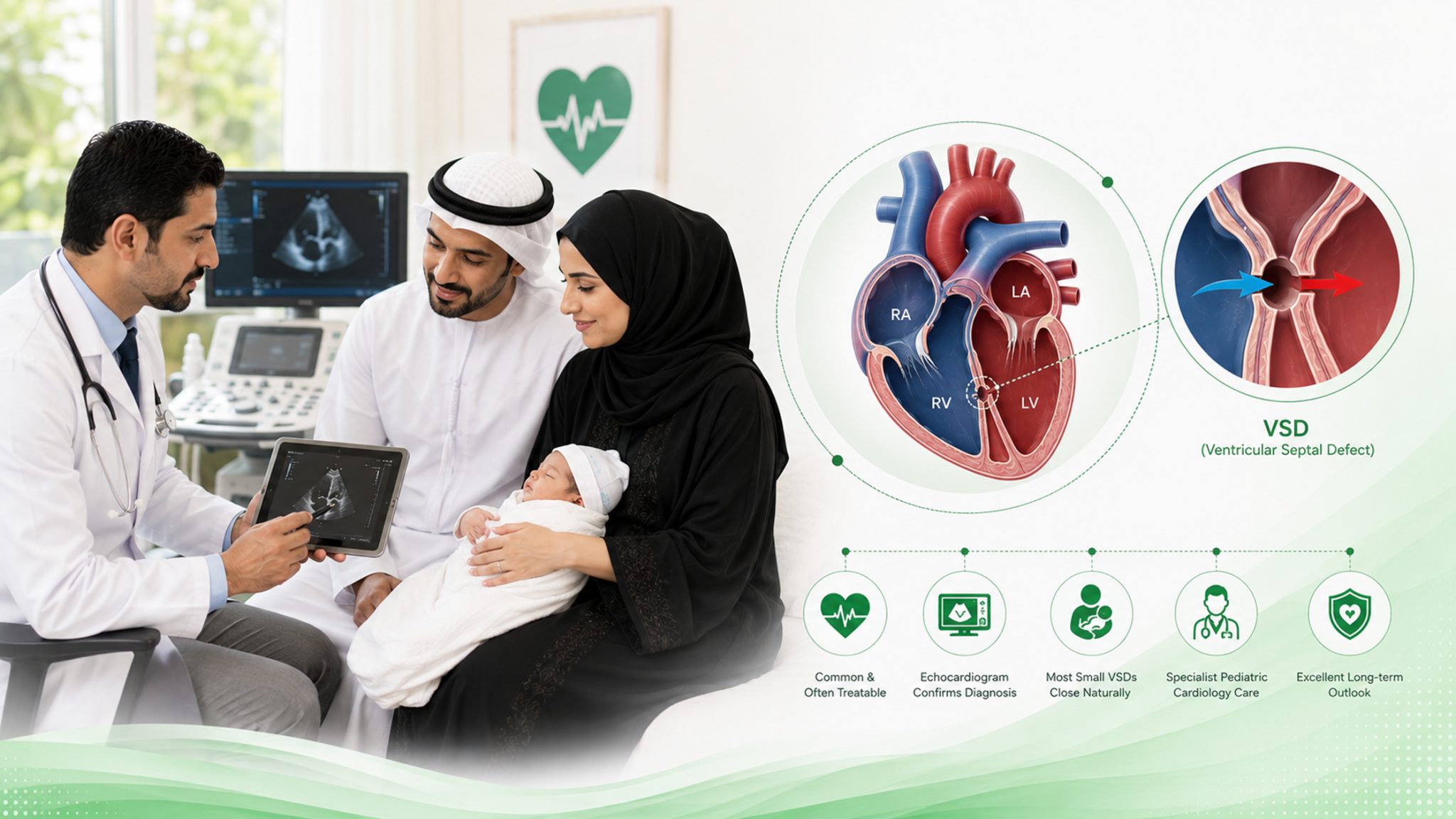
The heart has two lower chambers, the ventricles, separated by a muscular wall called the septum. A VSD is a gap in that wall, one that didn’t fully close while the heart was forming in the womb. Blood that should stay on the left side, headed out to the body, leaks through the gap into the right side instead, mixing with blood headed to the lungs.
That sounds more dramatic than it usually is in practice. A small VSD often changes almost nothing about how a baby feeds, grows, or breathes. The heart works around it. It’s really the size of the hole, not its mere existence, that determines what happens next.
How the Diagnosis Actually Gets Made
Most VSDs are picked up the way this one was: a heart murmur heard during a routine physical exam, sometimes in the hospital nursery, sometimes at a first pediatrician visit weeks later. A murmur alone doesn’t confirm a VSD. It’s a clue that prompts an echocardiogram, a painless ultrasound of the heart that shows the hole directly, measures it, and shows how much blood is passing through it.
Some VSDs are caught earlier still, on a prenatal scan, which is part of why fetal cardiac imaging has become such a routine part of pregnancy care for families with any known risk factors. Whether the diagnosis comes before birth or after, the next steps look largely the same.
Why Most Small VSDs Don’t Need Surgery
This is the part that surprises parents most: a large share of VSDs close on their own, usually within the first one to two years of life, sometimes later. The muscular tissue around a small hole continues to grow and can seal it shut without any intervention at all. For a baby with a small, isolated VSD and no symptoms, the standard approach is watchful monitoring rather than immediate treatment, a series of follow-up echocardiograms spaced out over months to track whether the hole is shrinking.
That watchful approach isn’t a wait-and-hope shrug. It’s a deliberate clinical strategy, chosen because intervening on a defect likely to close by itself carries more risk than benefit.
Signs Parents Are Asked to Watch For at Home
For a baby being monitored rather than treated immediately, most of the day-to-day responsibility sits with the parents, and it comes down to noticing a short list of things:
- Faster or heavier breathing than usual, especially during feeds
- Sweating around the head or forehead while feeding
- Taking unusually long to finish a bottle or breastfeed
- Slower weight gain than expected at well-baby visits
- Unusual paleness or bluish tint around the lips
None of these on their own mean something has gone wrong. Together, or persisting over more than a feeding or two, they’re worth a call to the pediatric cardiology team rather than a wait until the next scheduled visit.
When a VSD Does Need Treatment
Larger VSDs, or ones causing real symptoms, are a different conversation. When a hole is forcing the heart and lungs to work too hard, a baby can develop poor weight gain, rapid breathing, or signs of heart strain that don’t resolve with watching and waiting. In those cases, closing the defect becomes the right next step rather than a last resort.
Two approaches exist, and which one applies depends entirely on the defect’s location and size. Some VSDs can be closed through interventional cardiac catheterisation, a minimally invasive procedure that reaches the heart through a blood vessel rather than open surgery. Others, particularly larger or more complex holes, still require open-heart surgical repair. Both options are available to families through KidsHeart’s Dubai-based cardiology team, with Abu Dhabi and Al Ain families referred into the same pathway for anything beyond initial diagnosis and monitoring.
What Ongoing Care Looks Like
Whether a VSD closes on its own, gets repaired through catheterization, or is corrected surgically, the story doesn’t end at the moment the hole is gone. Children who’ve had a VSD, treated or not, typically stay under some form of cardiology follow-up through childhood, with periodic exams to confirm the heart is functioning normally as the child grows. For babies who needed a procedure, post-surgical cardiac follow-up care tracks healing and long-term heart function well beyond the hospital stay.
Most of these children eventually get discharged from cardiology care entirely, once follow-up imaging confirms the heart has settled into a normal, stable pattern with nothing left to monitor.
The Diagnosis That Rarely Stays the Headline
That first conversation on day two of life, murmur and all, tends to feel much larger than it ends up being. Most families with a VSD diagnosis spend far more time on ordinary newborn things, sleep schedules, feeding routines, the first smile, than on the heart condition itself. The Dubai clinic exists to make sure that stays true, with clear answers early and a monitoring plan that doesn’t ask parents to guess whether something is wrong. For families in Abu Dhabi and Al Ain navigating the same diagnosis, the path runs through the same Dubai-based team, and it starts with booking an appointment.