
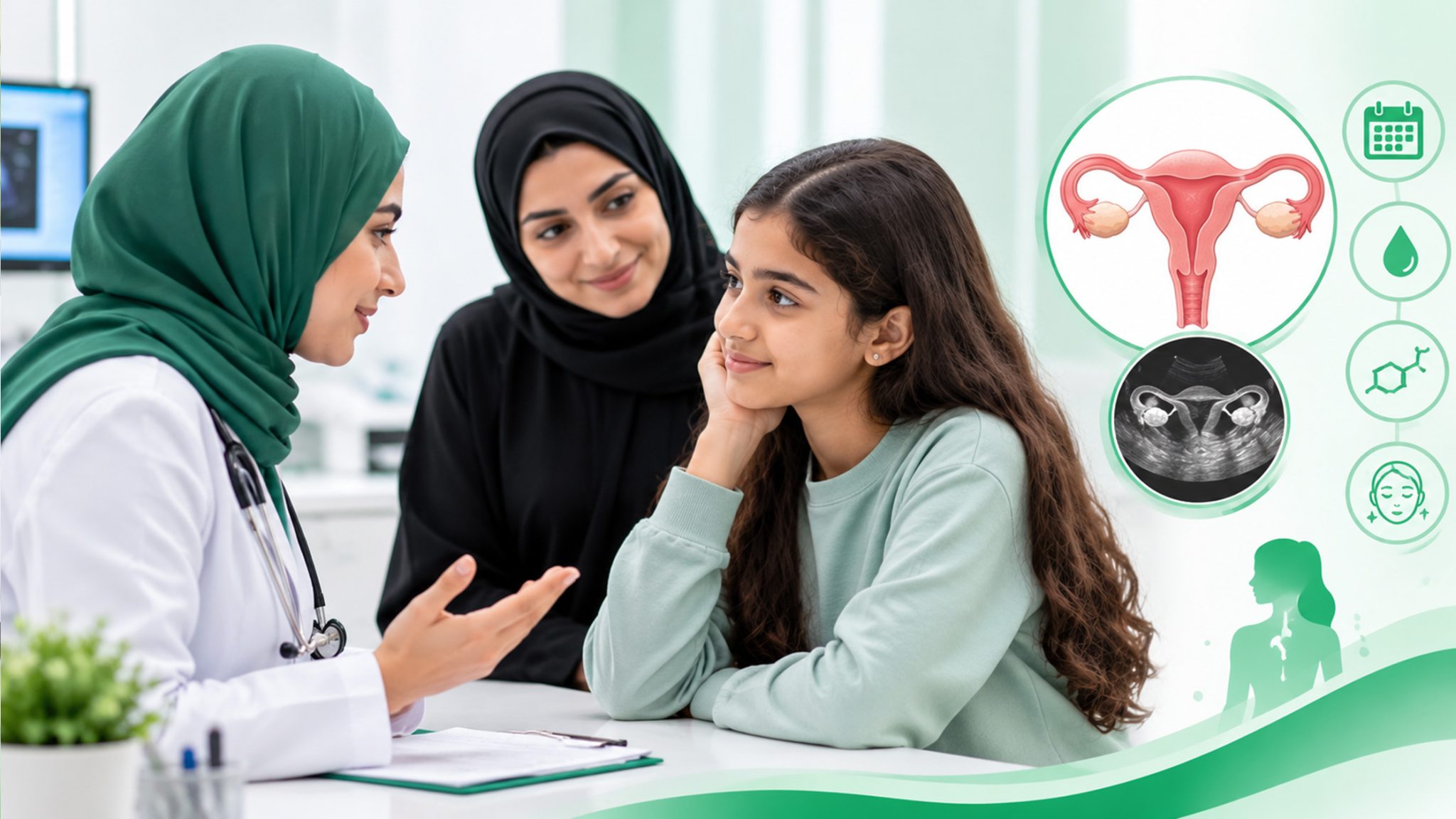
Polycystic ovary syndrome (PCOS) usually starts in the teenage years and is usually diagnosed years later, often in a woman’s twenties or thirties, when she is trying to get pregnant or a routine blood test shows raised sugar. By then, the signs have often been there since she was fifteen: periods that never settled, acne that resisted every cream, dark hair on the upper lip or chin that she quietly learned to remove.
It is one of the most common hormone conditions in women. The US Centers for Disease Control and Prevention describes PCOS as affecting as many as 5 million women in the United States, and notes that more than half of women with PCOS develop type 2 diabetes by age 40. An earlier diagnosis gives a teenager years to change that course.
It is also one of the most misunderstood, with plenty of half-truths passed between friends, relatives, and the internet. KidsHeart’s Gynecology Care team, based in Abu Dhabi with care also available in Dubai, sees teenage girls and their mothers who arrive carrying several of them. Each is worth correcting.
Irregular periods at thirteen are not automatically PCOS
This is the correction that surprises parents most. In the first year or two after a girl’s first period, irregular cycles are normal. The hormone system that controls ovulation takes time to settle, and long gaps between periods are common.
That is exactly what makes PCOS hard to diagnose in teenagers. Doctors generally look for cycles that are still irregular two to three years after periods began, or periods more than about three months apart at any point after the first year. In practical terms, between one and three years after the first period, cycles shorter than 21 days or longer than about 45 days count as irregular. After three years, the range narrows to roughly 21 to 35 days. A teenager with irregular periods eighteen months after her first one may simply be early in the process.
Being cautious about the label is not the same as ignoring the signs. A teenager whose cycles are irregular and who also has other features can be described as “at risk” and followed up, with the diagnosis confirmed or ruled out as her cycles mature.
A family history adds weight. PCOS often runs in families, and a teenager whose mother, aunt, or older sister has it, or whose parents have type 2 diabetes, is more likely to have it too.
The ultrasound is not the main test
The name suggests that PCOS is about cysts on the ovaries. It is not, quite. The “cysts” are small follicles, eggs that started developing and stopped, and teenage ovaries often look like this anyway.
For that reason, current international guidelines advise against using an ovarian ultrasound to diagnose PCOS in girls within about eight years of their first period. In teenagers, the diagnosis rests on two things together: irregular cycles that persist, and signs of raised androgens, the hormones present in all women but usually at lower levels. Those signs can be physical, such as stubborn acne or excess hair growth, or measured on a blood test.
Blood tests also rule out other causes of similar symptoms, including thyroid problems, raised prolactin, and rarer adrenal conditions. That step matters, because some of those conditions need entirely different treatment.
It is not simply a weight problem
Many girls with PCOS gain weight more easily, and losing weight can improve their cycles. But weight is not the cause, and many girls with PCOS are slim.
Much of PCOS comes back to insulin resistance, a state in which the body needs more insulin than usual to keep blood sugar normal. High insulin levels push the ovaries to make more androgens, which disrupts ovulation and drives acne and hair growth. A dark, velvety patch of skin at the back of the neck or in the armpits, called acanthosis nigricans, is one visible sign of this.
Advice about food and activity is part of treatment, but it works best when it is about steady habits rather than restrictive dieting. Teenagers with PCOS are more vulnerable to unhealthy eating patterns, and a doctor who frames everything around the scale can make that worse.
Acne and hair are not just cosmetic
For a fifteen-year-old, persistent acne or hair on the face is not a minor concern, and it should not be treated as one. These symptoms affect confidence, friendships, and how a girl feels walking into a classroom.
They are also treatable, and that message matters as much as any prescription. Waxing, threading, and laser treatment all have a place for hirsutism, the medical term for excess hair growth, and none of them is cheating. Depending on the picture, options include acne treatments, hair removal methods, and medicines that lower the effect of androgens on the skin. Taking these symptoms seriously is often what brings a teenager to her first gynecology appointment in the first place.
Mood deserves the same attention. Girls and women with PCOS have higher rates of anxiety and low mood. A good assessment asks about this directly.
A diagnosis does not mean she cannot have children
This is often the first fear mothers mention, sometimes before their daughter has said anything about it.
PCOS is a common cause of irregular ovulation, and some women with it need help to conceive later in life. Many do not. Many others conceive with relatively simple treatment. A diagnosis at sixteen says nothing definite about a pregnancy at thirty, and there is no reason to frame it that way to a teenager.
Women with PCOS do carry a higher risk of gestational diabetes in pregnancy, which is one reason the post on the glucose test in pregnancy is useful reading for the future. Knowing about PCOS years ahead means that screening can be planned early.
The teenage years are the right time
Long-term health is the strongest argument for a diagnosis at fifteen rather than thirty. Insulin resistance that goes unnoticed for years raises the chance of type 2 diabetes, high cholesterol, and high blood pressure in early adulthood. Some young women with PCOS also develop sleep apnea, snoring heavily and waking unrefreshed, which is easy to miss.
Habits formed in the teenage years tend to last. A girl who learns at sixteen that regular activity steadies her cycles and her energy has a head start that no medicine can give her later. Annual checks of blood sugar and cholesterol, started early, turn a future problem into something seen coming.
There is also the simple relief of a name. Many teenagers have spent years thinking their skin, their hair, or their cycle meant something was wrong with them personally. Hearing that it is a recognized, common, treatable condition changes how they carry it.
Waiting and doing nothing are different things
Even when the diagnosis is not yet certain, there is plenty a gynecologist can do. Treatment for teenagers usually focuses on what bothers the girl most and on protecting her long-term health:
- Regulating periods, often with a hormonal pill that also helps acne and hair growth
- Metformin, in some cases, to improve insulin resistance
- Skin and hair treatments alongside
- Regular checks of blood sugar, cholesterol, and blood pressure
- Support with sleep, activity, and eating habits
Very long gaps between periods also matter in their own right. When the lining of the womb builds up for months without being shed, doctors usually recommend treatment to make sure a period comes regularly, which protects the lining over time.
More on the treatment options is on KidsHeart’s PCOS management page.
The first appointment
Many teenagers are nervous about seeing a gynecologist, often because they assume an internal examination is involved. For a teenage girl with suspected PCOS, it usually is not. The visit is mostly a conversation, a general examination of the skin, weight, and blood pressure, and a blood test.
A mother or another trusted adult can be in the room. It also helps to give the teenager a few minutes to speak with the doctor on her own, since some questions are easier to ask without a parent listening. KidsHeart’s adolescent gynecology service in Abu Dhabi is set up for exactly these visits.
The blood test usually checks testosterone and other androgens, thyroid function, and prolactin, and often blood sugar or HbA1c and cholesterol as well. Some hormone tests are most accurate early in the morning or at a particular point in the cycle, so the doctor may ask for the sample to be taken on a specific day. If she is already taking a hormonal pill, mention it, because it changes the results.
Before the appointment, write down the dates of her periods for the past few months, even roughly. A phone app works well. Note when her periods started, any medicines she takes, and whether diabetes or PCOS runs in the family.
For families in Abu Dhabi and Dubai, the next step is to make an appointment and bring that list.