


Verbal Behavior & Functional Communication Plan (VB-FCP)

Verbal Behavior & Functional Communication Plan (VB-FCP)

ABA-Based Support for Building Verbal, Non-Verbal, and Augmentative Communication
Verbal Behavior & Functional Communication Plan (VB-FCP) Applied Behavioral Analysis Dubai Al Ain Abu Dhabi

At KidsHeart Medical Center – Abu Dhabi, we help children find their voice—through spoken words, gestures, picture-based systems like PECS, or high-tech AAC devices. Anchored in Applied Behavior Analysis (ABA) and the science of Verbal 

Behavior (VB), the VB-FCP serves children who struggle to initiate language, comprehend others, or use alternative ways to communicate. Every goal and teaching method is data-driven, measurable, and tied to real-life success. Learn more about our behavioral therapy programs here.

Verbal Behavior & Functional Communication Plan (VB-FCP) Applied Behavioral Analysis Dubai Al Ain Abu Dhabi
Communication Is More Than Speaking - It's Having a Way to Be Heard ABA Therapy KidsHeart Abu Dhabi Al Ain

Communication Is More Than Speaking - It's Having a Way to Be Heard

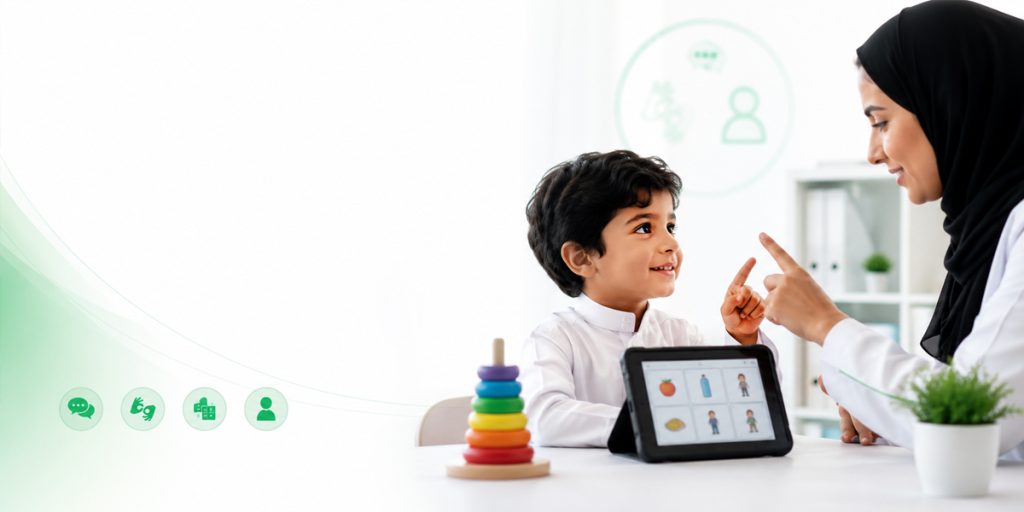
For children who can’t yet use words reliably, every unmet need becomes a behavior. Meltdowns, grabbing, biting, and shutting down are often communication attempts in the absence of a better system. A Verbal Behavior and Functional Communication Plan builds that system – spoken, gestural, or device-based – so the behavior has somewhere else to go.

Non-Verbal Children Have Communication Goals Too

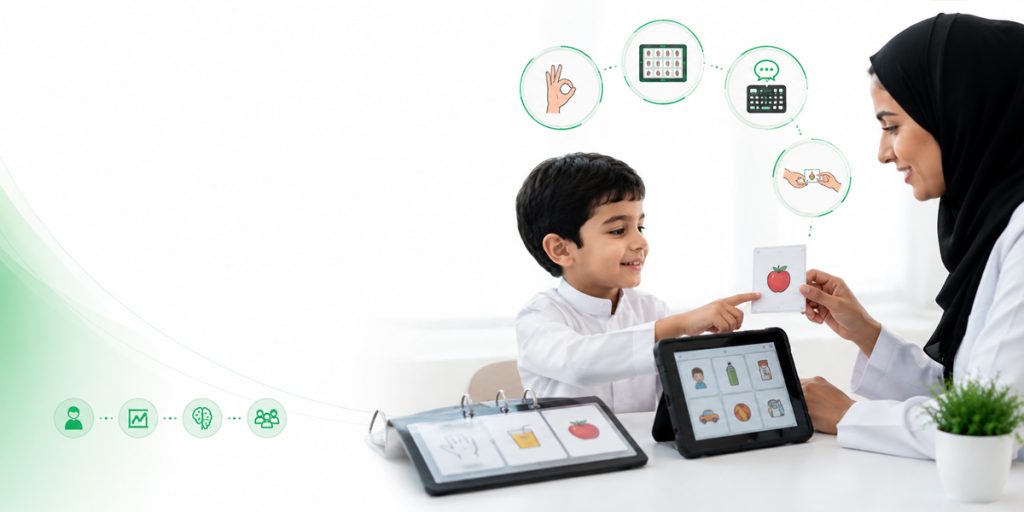
A child who doesn’t use speech may still learn to use picture exchange systems (PECS), sign approximations, or a speech-generating device to request, label, and engage. The VB-FCP covers every modality – and no AAC system is introduced until data show it will actually reduce frustration and expand what the child can express.

Requesting Is the First and Most Important Communication Goal ABA Therapy KidsHeart Abu Dhabi Al Ain

Requesting Is the First and Most Important Communication Goal

Manding – the ABA term for requesting – is the foundation everything else is built on. A child who can reliably ask for what they need is less frustrated, less likely to use behavior to communicate, and more motivated to engage with the adults and peers around them. It’s where almost every VB-FCP starts.

Coordinated With Speech Therapy, Not Separate From It

VB-FCP is grounded in behavioral science and uses ABA teaching procedures – systematic prompting, differential reinforcement, error correction – that complement but are distinct from traditional speech therapy. Our team works with speech-language therapists directly, so both sides of your child’s communication support are pulling in the same direction.

Goals Are Assessed Every 8–12 Weeks and Updated Based on Data ABA Therapy KidsHeart Abu Dhabi Al Ain

Goals Are Assessed Every 8–12 Weeks and Updated Based on Data

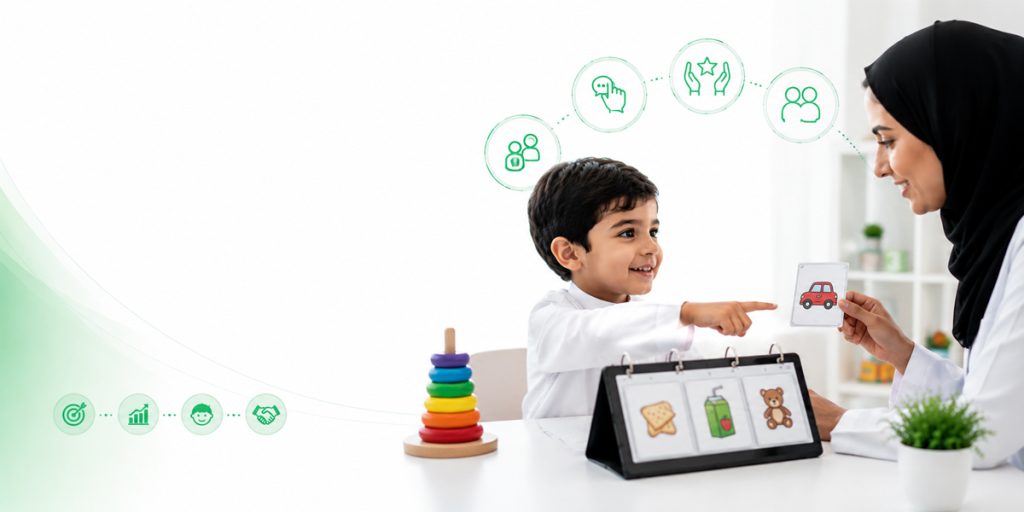
Communication goals aren’t set once and followed indefinitely. Weekly data graphing lets our team see what’s progressing, what’s plateauing, and what needs a different approach – so your child is never working toward a target that’s already been mastered or one that’s no longer the right priority.

Communication Support in Abu Dhabi

KidsHeart’s VB-FCP program is available at our Abu Dhabi locations, led by behavior analyst clinicians working alongside speech-language specialists. No diagnosis is required – a noticeable barrier to functional communication is the only criterion for starting.

Communication Support in Abu Dhabi ABA Therapy KidsHeart Abu Dhabi Al Ain

What Does the VB-FCP Include?

  • Comprehensive baseline assessment using tools such as VB-MAPP and ABLLS-R.
  • SMART goals across all verbal operants and related skills:
    • Mands (requesting)
    • Tacts (labelling)
    • Intraverbals (conversation, WH-questions)
    • Echoics (speech clarity)
    • Listener responding (following directions, answering)
    • Non-verbal cues (eye contact, pointing, gestures)
    • AAC proficiency—from picture-exchange systems like PECS to speech-generating devices, selected only when data show added value
  • ABA teaching procedures—systematic prompting, differential reinforcement, error-correction, and prompt-fading to secure generalization and maintenance.

When Should You Seek Support?

Consider the program if your child:

  • Uses no meaningful words or gestures by 18–24 months, or language growth has stalled.
  • Speaks very little, mainly echoes, or relies on tantrums and crying to communicate.
  • Struggles to follow simple directions or engage with peers.
  • Uses an AAC system (e.g., PECS) but is not making functional progress.

No diagnosis is required—the only criterion is a noticeable barrier to effective communication.

What Happens at KidsHeart?

  1. Functional Communication Assessment
    Direct observation, caregiver interviews, and baseline data.
  2. Individualized Intervention Plan
    Communication targets integrate with the child’s IEP (when present) to align academic, developmental, and behavioral goals.
  3. Therapy Sessions
    • One-to-one sessions for intensive skill acquisition several times a week.
    • Group sessions to practice turn-taking, conversation, and social language with peers.
  4. Parent & Teacher Training
    Live modeling, role-play, and easy-to-follow home/school protocols ensure consistency across settings.
  5. Ongoing Data Review
    Weekly graphing; goals updated every 8–12 weeks based on measurable progress.

Why Choose KidsHeart?

  • Led by behavior analyst clinicians and coordinated with speech-language therapists.
  • Combines intensive individual teaching with structured group practice for generalization.
  • Explicit emphasis on alternative communication systems—from low-tech PECS to high-tech devices—introduced only when evidence supports their benefit.
  • Continuous graph-based decision making keeps intervention efficient and effective.
  • Genuine family partnership so gains transfer beyond the clinic.


Expression Unlocks Possibility

KidsHeart’s VB-FCP turns communication barriers into bridges for learning, relationships, and independence, helping every child say what they need to say, in the way that works best for them.

Frequently Asked Questions (FAQs)

Absolutely; we serve every communication level, including exclusive PECS or device users.

We target intelligibility—speech sounds, sentence structure, and reinforcement that reduces errors.

VB-FCP embeds ABA procedures—task analysis, systematic prompting, differential reinforcement—often complementing speech therapy.

Only if an AAC evaluation shows that a PECS book or speech-generating device will reduce frustration and meet goals.

Yes. Parent modeling and simple data sheets are integral; we teach every step.