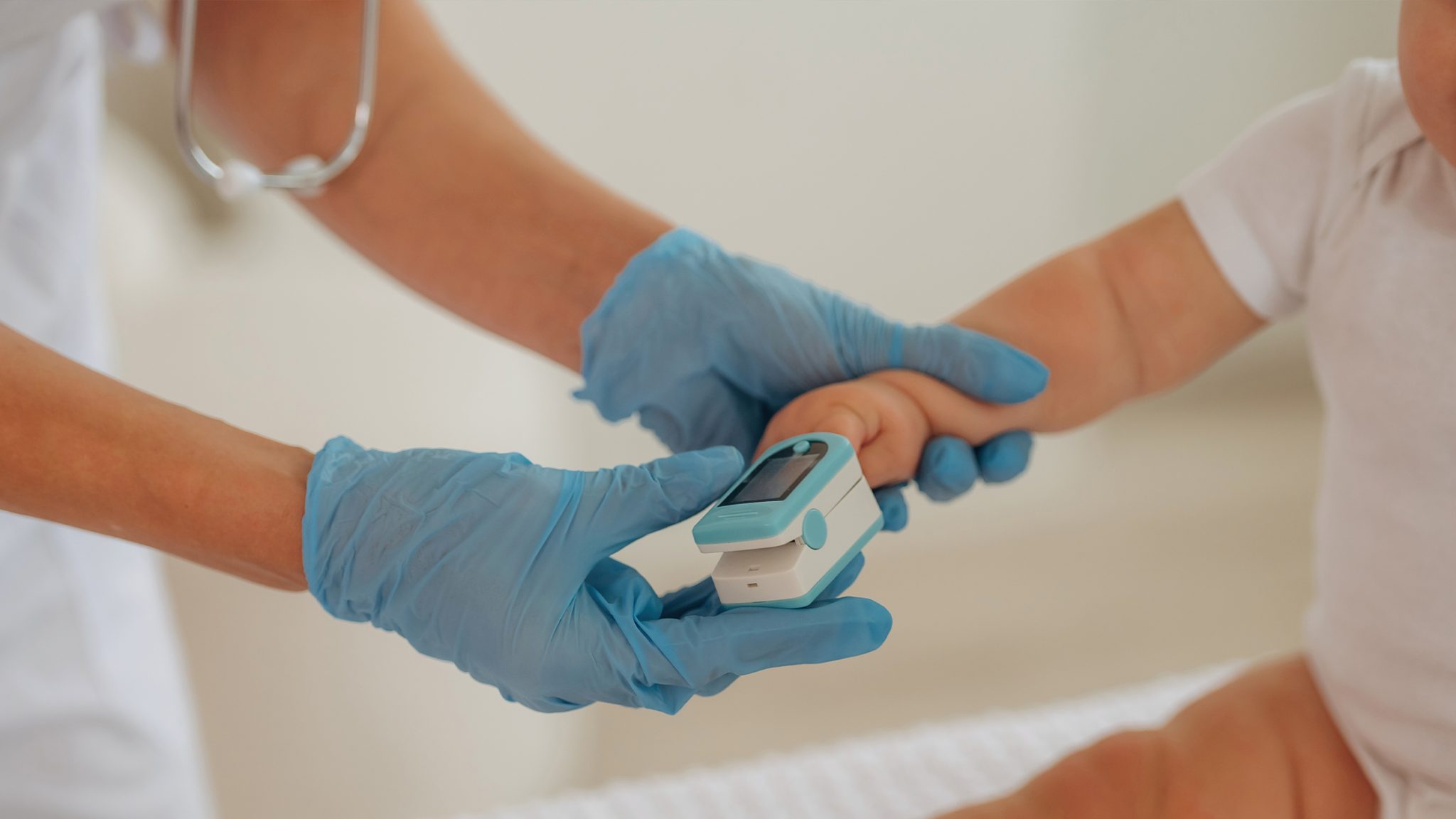
What the light on the foot is actually measuring
A pulse oximeter shines red and infrared light through the skin and calculates oxygen saturation: the percentage of red blood cells carrying oxygen. In a healthy newborn after the first day, that figure normally sits in the mid to high 90s.
The screen compares two readings. The right hand receives blood that left the heart before reaching a vessel called the ductus arteriosus. The foot receives blood that may have passed through it. In some heart conditions, blood low in oxygen flows through that vessel to the lower body, so the foot reads lower than the hand.
So the test is checking two things: whether either number is too low, and whether there is a meaningful gap between them.
Timing matters. Screening is usually done after the baby is 24 hours old, because readings in the first hours of life are naturally lower while the circulation settles. A baby discharged earlier may be screened just before leaving, with the team taking that timing into account.
The conditions it is designed to catch
The target is critical congenital heart disease (CCHD): heart defects serious enough that a baby usually needs surgery or a catheter procedure within the first year, often within the first weeks. According to the CDC’s screening guidance, about 1 in 4 babies born with a heart defect has a critical one, and mandated pulse oximetry screening reduces early infant deaths from critical CHD by 33 percent.
The list includes conditions such as hypoplastic left heart syndrome, transposition of the great arteries, tetralogy of Fallot, pulmonary atresia, tricuspid atresia, truncus arteriosus and total anomalous pulmonary venous return. The names are long and unfamiliar. What they share is a heart that cannot deliver well-oxygenated blood to the body on its own once the newborn circulation takes over.
Many of these defects depend on the ductus arteriosus staying open after birth. While it is open, blood finds a way around the problem. When it closes, typically in the first days of life, the baby can deteriorate within hours.
Some critical defects are found during pregnancy on a detailed scan, and a fetal echo can confirm them before delivery. Our post on detecting CHDs early covers that prenatal side. Not every defect shows up before birth, though, and pulse oximetry is a second net for the ones that did not.
Why the timing sits so close to discharge
The ductus usually narrows over the first one to three days of life. That is roughly the same window in which most healthy newborns go home. A baby born on a Tuesday morning in Dubai may well be in a car seat by Wednesday evening, and a baby with a duct-dependent defect may look entirely normal on both days.
The screen is placed in that gap deliberately. Done after 24 hours, it gives the circulation time to settle so the readings are meaningful, while still catching most babies before the duct closes and before they leave the reach of the neonatal team.
For a baby born by cesarean section who stays three or four days, the timing is more forgiving. For a baby discharged at 24 to 36 hours, the screen is often one of the last checks done, and it deserves the same care as any other. Hospitals in Dubai, Abu Dhabi and Al Ain each have their own discharge routines, so the simplest approach is to ask, before leaving, whether the screen has been done and what the result was.
Pass, repeat, or refer
There are three possible outcomes, and only one of them is a cause for further tests.
A pass means both readings are in the expected range and close to each other. No further screening is needed.
A repeat result means the numbers are borderline. The baby is usually rechecked about an hour later, sometimes twice. Cold hands and feet, crying and a wriggling foot can all affect the reading, and many babies pass on the second or third attempt.
A failed screen means the readings stayed too low or too far apart. The next step is a careful examination and, in most cases, an echocardiogram.
A failed screen is not a diagnosis. Low oxygen readings in a newborn have other explanations, including:
- Fluid in the lungs that has not cleared yet (transient tachypnea)
- Infection, including pneumonia
- Pressure in the lung vessels that has not dropped as expected after birth
These matter too, and the screen helps bring them to attention early.
When a baby is referred, things usually move quickly, and the first priority is an echocardiogram. This is a painless ultrasound, done with the baby lying on a parent’s lap or a padded bed, that shows the structure of the heart chambers, valves and major vessels.
The scan takes roughly 30 to 45 minutes. Babies often settle best if they are fed shortly before or during it, and a parent can usually stay close the whole time. Warm gel and a small probe are all the baby feels.
At our Dubai Healthcare City clinic, the cardiologist reviews the screening readings, examines the baby, and performs or reviews the echo. If the heart is structurally normal, the conversation turns to the other causes of low oxygen, often in coordination with the baby’s pediatrician. If a defect is found, the plan depends on what it is: monitoring for a minor finding, or urgent coordination with a cardiac surgical center for a critical one.
The approach is the same for families seen at the KidsHeart branches in Abu Dhabi or at The Heart Medical Center in Al Ain. Our page on heart defects in newborns describes how early evaluation and follow-up are organized.
What the screen can miss
Pulse oximetry is a strong screen, not a perfect one. It works best for defects that lower oxygen levels. Some significant conditions, including certain forms of coarctation of the aorta and many holes between heart chambers, can leave oxygen saturation completely normal in the first days.
That is why a pass does not override other signs. A newborn who feeds poorly, breathes quickly at rest, sweats during feeds, looks gray or blue around the lips, or seems unusually sleepy needs to be seen, whatever the screen said at discharge. A blue tinge in particular should never wait; our post on blue baby syndrome explains the main causes and when to act.
The same applies to a family history of heart defects, a known genetic condition, or a concern raised on a pregnancy scan. In those situations a pediatrician may arrange an echocardiogram regardless of the oximetry result, because the screen was never designed to answer those questions.
Some defects also produce a murmur that is heard only at the first weeks’ check, as pressures in the heart change. A screen at 24 hours and a stethoscope at two weeks are looking at different moments in the same transition.
Checking the discharge papers
Most parents never find out what their baby’s oxygen numbers were. The result is often recorded in the discharge summary or the baby’s health booklet, sometimes as a simple “pass.” It is worth a glance before leaving the hospital, and worth asking about if it is missing, particularly after a very early discharge or a birth outside a hospital.
A parent who knows the number has something specific to share if a question arises later: “the screen passed at 26 hours, hand 99 and foot 98” is more useful to a doctor than “I think they did a test.”
If the screen was not done, the baby’s pediatrician can arrange it. If it was done and passed, it sits alongside every other check in the first weeks, not above them. And if a heart question comes up later, from a murmur, a feeding pattern or a color change, our Dubai team and colleagues in Abu Dhabi and Al Ain can be reached through the KidsHeart contact page to arrange an assessment.
Consultant, Fetal & Pediatric Cardiologist – American Board
Assistant professor, Columbia University, New York
Pediatric Cardiac Surgeon – American Board

Dr. Mohamed Sulaiman

Dr. Emile A. Bacha