



Dyslexia
Dyslexia
Clear Steps. Trusted Tools. Thoughtful Answers.
Some children are bright, curious, and eager — yet struggle unusually with reading, spelling, or writing. Dyslexia is a specific learning difference that affects how the brain processes written language.
At KidsHeart Medical Center, we help families understand these challenges early and offer supportive, evidence-based strategies to move forward.
We provide dyslexia evaluations and developmental planning for children across Dubai, Abu Dhabi, and Al Ain.
Smart Kids Can Still Struggle to Read
A child who talks in complex sentences and thinks quickly can still stumble badly over decoding words on a page – the two aren’t related. Dyslexia affects how the brain processes written language, not how intelligent a child is.
Letter Reversals Are Usually Nothing
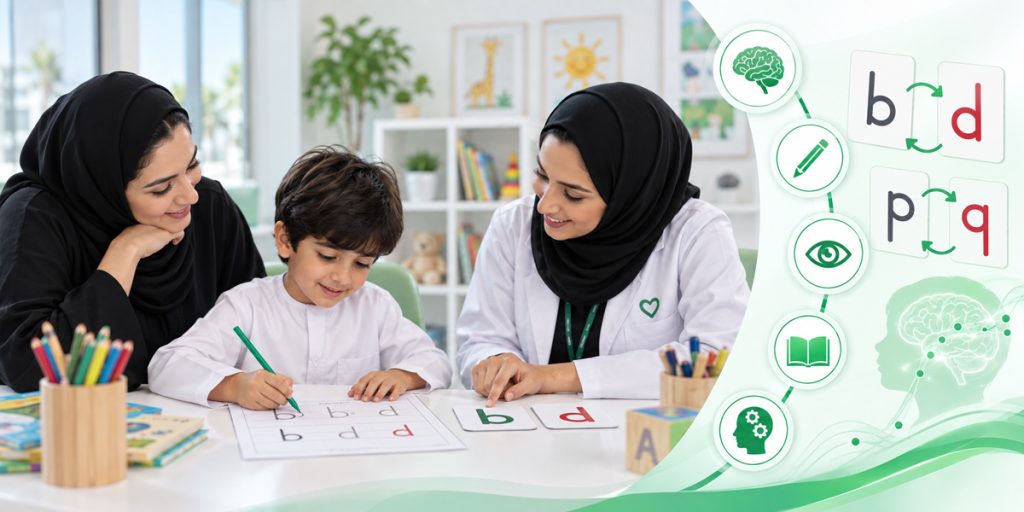
Writing a “b” as a “d” is common in early writing and resolves on its own for most kids. What’s worth watching is a pattern that persists past the age when peers have moved on.
What the Evaluation Actually Measures
Testing covers phonics, working memory, processing speed, and how your child approaches a reading task, not just a single score. The picture that comes out of it explains why reading feels hard, not just that it does.
Family History Matters Here
Dyslexia often runs in families, so a parent or sibling who struggled with reading is a meaningful clue worth mentioning at the first visit. It doesn’t confirm anything on its own, but it shapes how we look.
A Learning Profile That Changes Over Time
The strategies that help a six-year-old aren’t the same ones a twelve-year-old needs, so we treat this as something to revisit, not a single fixed label. Regular check-ins keep the plan matched to your child.
Reading Support Across Abu Dhabi, and Al Ain
Wherever your family lives, the same evaluation team and follow-up planning are within reach. Getting started doesn’t require a long commute.
What Does Dyslexia Look Like?
Dyslexia can vary in how it appears, but often includes:
- Trouble sounding out words or matching letters to sounds
- Difficulty reading smoothly or aloud
- Problems with spelling, even simple words
- Avoiding reading or saying it feels “too hard”
- Strong verbal thinking but weak written expression
It’s not about intelligence or effort — it’s about how the brain handles written language. With the right tools, children with dyslexia can thrive.
When Should You Consider an Evaluation?
You may want to seek a developmental review if your child:
- Is reading below grade level despite regular instruction
- Confuses similar letters or words (e.g., “b” and “d”, “was” and “saw”)
- Has difficulty remembering sight words or spelling rules
- Becomes frustrated or anxious about reading and writing
- Has a family history of dyslexia or language-based learning differences
These signs are often most noticeable between ages 5 and 8 — but help can start earlier or later, depending on the child.
How We Evaluate and Support
Our dyslexia assessments are adapted to your child’s age and learning profile. The process may include:
- Developmental and academic history
- Standardized reading, phonics, and language testing
- Cognitive skill screening (e.g., working memory, processing speed)
- Observations of how your child approaches tasks
- Collaboration with teachers and tutors, if appropriate
- Clear explanation of results and practical recommendations
Our goal is not just to name the difficulty — but to guide you toward meaningful support.
Why Choose KidsHeart?
- Specialists trained in developmental neurology and learning profiles
- Tools that detect not just what’s difficult, but why
- Recommendations tailored to school support, home strategies, and therapy
- A child-centered approach that protects confidence
- Convenient access to services across Dubai, Abu Dhabi, and Al Ain

Clarity for Today. Confidence for Tomorrow
If your child is finding reading unusually hard, we’re here to help you understand why — and what to do next.
Frequently Asked Questions (FAQs)
No. Letter reversal is common in early writing. Dyslexia affects decoding, fluency, and language processing more broadly.
Yes — with targeted support, many children make strong progress and develop strategies that work for them.
No. If you’re noticing reading challenges, you can seek a private evaluation directly.
The learning profile may evolve. Regular monitoring helps adjust strategies as the child grows.
Not necessarily. Many children with dyslexia succeed in school and beyond — especially when their learning needs are supported early.