
A child who can count to a hundred may not be ready for KG. A child who can count to ten may be.
That surprises a lot of parents, and it is the most useful thing to understand before booking a school readiness evaluation. The assessment is not a test of how much a child already knows. It is a look at whether the child has the skills that make learning in a classroom possible: listening to an adult who is speaking to the whole group, waiting a turn, holding a pencil, managing a lunchbox, recovering when something goes wrong.
Most children are ready, or close enough that the first term sorts out the rest. Some are not, and a small number have a developmental difference that has not been noticed at home. The US Centers for Disease Control and Prevention estimates that about 1 in 6 children aged 3 through 17 have one or more developmental disabilities, many of which first become visible when a child meets the demands of school.
KidsHeart’s Pediatric Neurodevelopment team carries out these evaluations at the Al Karamah and MBZ branches in Abu Dhabi and at The Heart Medical Center in Al Ain. What follows describes what the evaluator is actually watching, area by area.
Language and listening
This is usually where the evaluation begins, because so much of KG depends on it.
The evaluator listens to how the child talks: whether sentences are clear enough for a stranger to understand, whether the child can tell a short story in order, and whether they can explain what they want without pointing. Just as important is how the child listens. Can they follow a two- or three-step instruction (“Put the car in the box, then bring me the blue pencil”)? Do they understand words like “under,” “before,” and “same”?
A child who often seems not to listen may not be hearing well. Fluid behind the eardrums, common after colds in the preschool years, can muffle sound for weeks at a time, and a hearing check is often part of the picture before anyone draws conclusions about attention.
Children growing up with two or more languages are assessed with that in mind. A child may be stronger in the home language than in English or Arabic, and the evaluator looks at overall communication rather than vocabulary in one language alone.
Attention and waiting
KG asks children to sit for short stretches, listen while someone else speaks, and wait for their turn. The evaluator watches how long the child can stay with a task they did not choose, how they react when asked to stop something they enjoy, and how often they need reminding.
Short attention spans are normal at four. What the evaluator looks for is attention that is much shorter than expected for the age, or that makes it very hard for the child to finish anything. Impulsive behavior, such as grabbing, interrupting constantly, or running off, is noted in the same way.
None of this leads to a quick label. Attention at this age changes fast, and a single morning tells only part of the story. Reports from the nursery and from home matter as much as what happens in the room.
Children who are young for the year
Birthdays matter more at four than at any later age. A child born just before the cut-off date can be almost a year younger than a classmate born just after it, and a year is a large slice of a four-year-old’s life.
For these children, families sometimes face a real choice between starting KG on schedule and waiting a year, where the school allows it. A readiness evaluation does not make that decision, but it gives families something firmer to weigh than a general feeling. A young child who is strong in language, attention, and self-care is often fine to start. A young child who is struggling in several areas may benefit from another year to grow.
Schools differ in their policies, so it makes sense to ask early what flexibility exists.
Hands, pencils, and scissors
Fine motor skills get less attention from parents than reading and counting, yet they cause a great deal of frustration in the first year of school.
The evaluator watches how the child holds a crayon or pencil, whether they can copy simple shapes such as a circle, a cross, and a square, and whether they can cut along a line with child-safe scissors. Building with small blocks, threading beads, and opening containers all give clues. A child who avoids drawing, tires quickly when holding a pencil, or still grips it in a fist may benefit from Occupational Therapy, which KidsHeart offers in Abu Dhabi and Al Ain.
Gross motor skills are checked as well: running, hopping, catching a large ball, and climbing stairs with alternating feet.
Looking after themselves
A classroom teacher has many children and limited time. Children who can manage their own basic care settle in faster.
The evaluator asks about, and sometimes watches, the practical self-care skills: using the toilet independently, washing hands, putting on shoes and a jacket, opening a lunchbox and drinks, and eating without much help. These skills are easy to overlook at home, where an adult often steps in before the child has to try. Giving a child a few months of practice before KG can make a real difference.
Getting along with others
Social skills often decide how a child feels about school, more than any academic skill.
The evaluator looks at how the child joins play, shares materials, copes when another child takes a toy, and responds to a new adult. They watch for eye contact, shared attention (looking at what someone else is pointing at), and back-and-forth conversation. A child who is very quiet with strangers is not necessarily a concern. A child who rarely engages with others, even familiar ones, or who has strong difficulties with changes in routine, may need a closer look.
Early numbers and letters
These come last for a reason. Recognizing some letters, counting a small group of objects, and knowing a few colors and shapes are useful, but they are the easiest skills to teach once the others are in place. A child who struggles here but does well in every other area usually catches up quickly in KG. Reading together every day, talking about numbers during ordinary moments such as setting the table, and letting a child see letters on signs and packets build these skills far better than worksheets at this age.
How the morning feels to the child
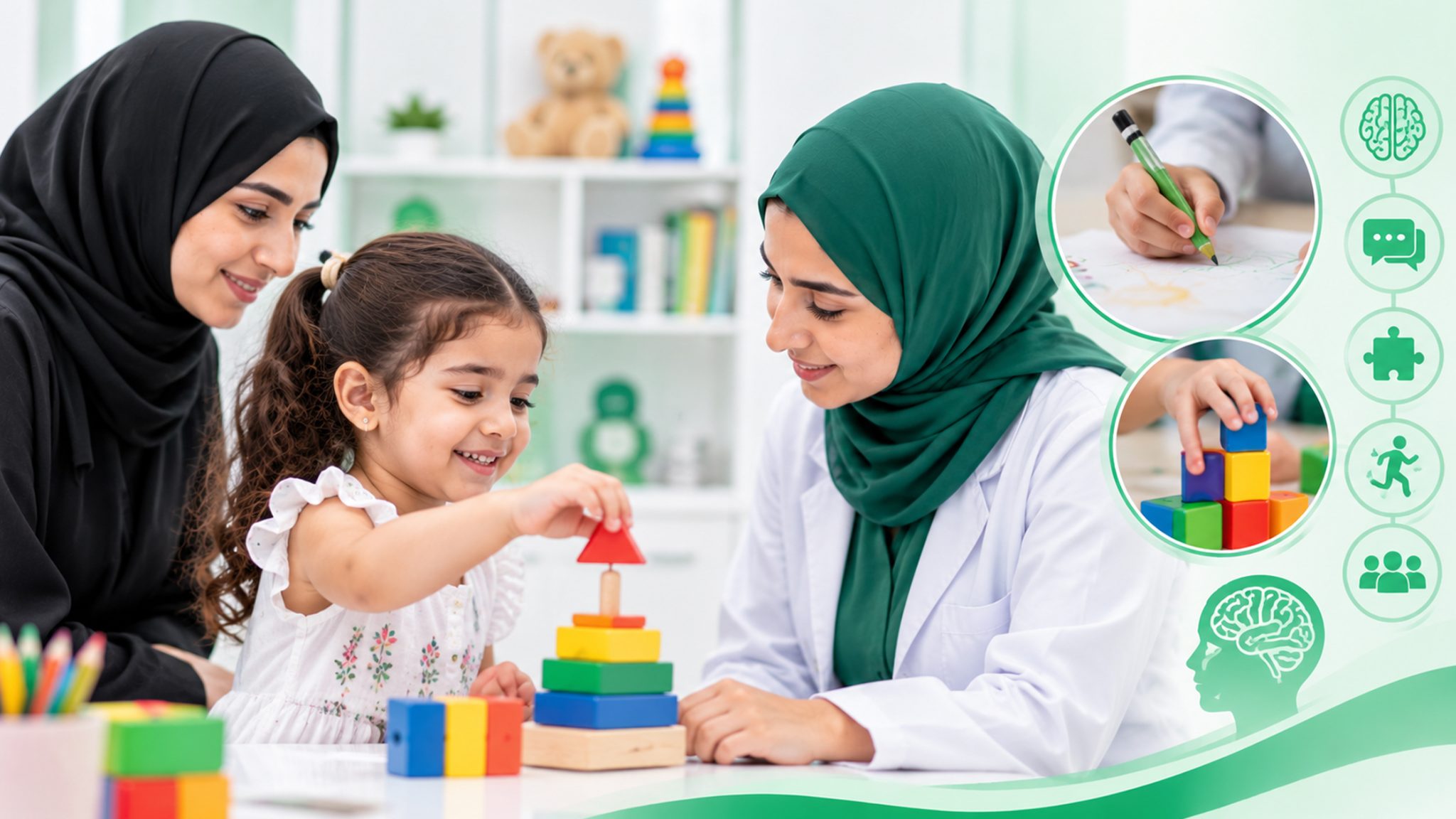
To a four-year-old, most of the evaluation looks like play. There are puzzles, picture books, building blocks, crayons, and a few games that involve following instructions. Short breaks are built in. Parents usually stay in the room, which helps shy children warm up, though the evaluator may ask them not to help with the tasks.
Some children perform brilliantly with a stranger and then fall apart at home. Others freeze in a new room and show only part of what they can do. Evaluators expect both, which is why they rely on reports from home and nursery as well.
What happens after the evaluation
Parents receive a summary of strengths and areas to work on, with specific suggestions. Most reports confirm that the child is ready, sometimes with a few skills to practice over the coming months.
If the evaluation raises a concern, the next step might be a fuller developmental assessment, a referral to speech therapy or occupational therapy, or guidance for the school on what support would help. The aim is to start that support before the first term, rather than after a difficult one. The post on early intervention explains why that timing matters.
A school readiness evaluation is separate from the medical checks many schools ask for at enrollment, such as vaccinations and hearing and vision screening. Those are covered in the post on school health checks, and it makes sense to arrange both before the school year begins.
Before the appointment
A little preparation helps the evaluator see a typical picture of the child:
- Bring any nursery reports, along with notes from the teacher if possible
- Note any concerns about hearing, vision, sleep, or behavior
- Bring a short list of the languages spoken at home and with whom
- Schedule the visit for a time of day when the child is usually alert, not just before a nap
- Tell the child they will be playing games with a new person, which is true
More on how KidsHeart runs these assessments is on the school readiness evaluations page.
The child who could count to a hundred and the child who could count to ten may both walk into KG ready. The evaluation is how a family finds out, with time left to help if the answer is not yet. Families in Abu Dhabi and Al Ain can reach the neurodevelopment team to arrange one in the months before school starts.