
The intake form at a routine check-up has a line most parents fill out on autopilot: “Family history of heart disease?” A pen hovers over the box. The honest answer, for a lot of families, is something closer to “not sure” than a clean yes or no. That evening, a phone call to a parent or an aunt turns up something nobody had connected before: an uncle who collapsed on a padel court at 44, a grandfather who died suddenly in his sleep at 51, always described in the family as “his heart just gave out.”
None of that ever made it onto a medical form before, because nobody thought to ask, and nobody realized it mattered for a child who’s never had a single symptom.
It matters more than most families assume. The American Academy of Pediatrics now recommends that every child, not just competitive athletes, be screened for sudden cardiac risk using a short set of family-history and symptom questions, repeated roughly every two to three years starting around middle school age. In the United States, about 2,000 people under 25 die of sudden cardiac events each year, and a family history of early cardiac death is one of the clearest predictors doctors currently have. That’s exactly the gap KidsHeart’s Sudden Cardiac Death Risk Assessment program, based at the Dubai Healthcare City clinic, is built to close.
The Question Most Parents Skip Over
“Family history” sounds like it should be simple to answer, but most people carry a patchy, half-remembered version of their own family’s medical past. A relative’s cause of death gets softened over the years into something vague: “his heart,” “she just went in her sleep,” “it ran in that side of the family.” Those phrases sound like closure. To a cardiologist, they’re a lead worth following.
The reason the question shows up on nearly every pediatric intake form isn’t bureaucratic caution. Several serious but treatable heart conditions run in families and produce no symptoms in a child until the moment they do, which is precisely the scenario a targeted screening is designed to catch earlier.
What Actually Counts as Relevant History
Not every heart-related death in a family tree changes how a child is screened. A grandparent who had a heart attack at 78 after decades of smoking is a very different data point than a parent who collapsed suddenly and unexpectedly at 40 with no clear explanation. The details that matter most to a pediatric cardiologist are the age at which something happened and whether it was sudden and unexplained rather than the result of long-term, age-related disease.
A family history worth flagging includes:
- Sudden, unexplained death in a relative under 50
- A diagnosis of cardiomyopathy, an enlarged or thickened heart muscle, in any relative
- Long QT syndrome or another named inherited heart rhythm disorder
- Multiple relatives with heart attacks or heart disease at a young age
- A relative who received an implantable defibrillator before age 40
One of these on its own is worth mentioning at the next appointment. Two or more, especially across generations, is worth a dedicated cardiology conversation rather than a note on a form.
Why These Conditions Hide So Well
Hypertrophic cardiomyopathy and long QT syndrome are the two conditions most often behind a family history like this, and both share an uncomfortable trait: a child can carry either one for years with completely normal energy, normal sports performance, and no complaints at all. Hypertrophic cardiomyopathy thickens the heart muscle in a way that can go unnoticed until physical exertion places real strain on it. Long QT syndrome affects the heart’s electrical timing, something a standard stethoscope exam can’t detect at all.
That’s the practical argument for family-history screening over waiting for symptoms. Genuinely dangerous versions of these conditions often produce their first noticeable sign during exactly the kind of intense activity, a sprint, a sports final, a hot afternoon of play, that a family least expects trouble from.
What a Family-History-Driven Screening Involves
A screening prompted by family history looks similar to any other cardiology visit at first: a detailed conversation about which relatives had what, at what age, and how it was described at the time. Old hospital records or death certificates, if a family happens to have them, can turn a vague family story into something a cardiologist can actually act on.
From there, a physical exam, an electrocardiogram, and often an echocardiogram build a picture of how the child’s own heart is structured and functioning. Depending on what the history suggests, genetic counseling and testing can identify whether a specific inherited condition is present, which matters not just for the child being seen but for siblings and future children too. This kind of proactive, risk-based approach is exactly what KidsHeart’s preventive pediatric cardiology program at the Dubai clinic is designed around, extending the same evaluation to families across Abu Dhabi and Al Ain who are referred in for the same reason.
When the Screening Extends to Parents Too
A family history conversation often runs in both directions. A parent who learns their own father died suddenly and young is, by definition, part of that same family history, and the honest next question is whether that parent has ever been screened themselves. KidsHeart’s Adult Cardiology team, also based in Dubai and available in Abu Dhabi and Al Ain, exists for exactly this moment, when a child’s workup uncovers a risk that belongs to the whole family tree, not just the youngest branch of it.
The Phone Call That’s Worth Making
That evening call to a parent or grandparent, the one digging up details that never made it onto a medical form before, is often the single most useful thing a family can do before a screening appointment. A cardiologist can only work with the history that’s actually been gathered. Families across Dubai, Abu Dhabi, and Al Ain who bring in that fuller picture, even an imperfect one pieced together from memory, give the screening far more to work with than a checked “no” box ever could.
Most family histories, once actually traced, turn out reassuring rather than alarming. For the smaller number where they don’t, that conversation is exactly what gets a child seen early enough to matter, and it starts with booking an appointment at the Dubai clinic.
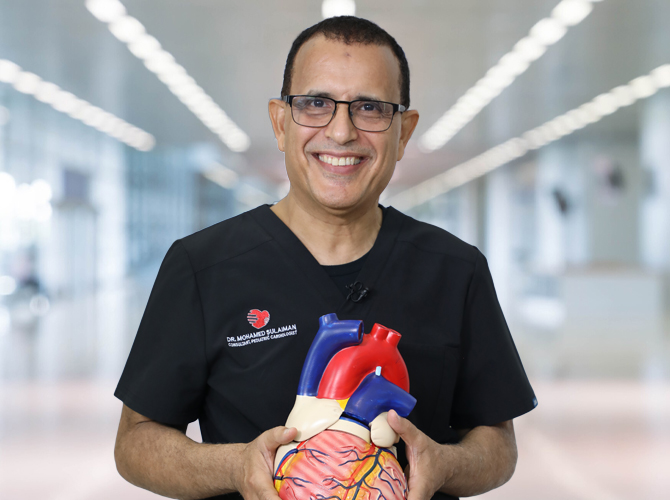
Dr. Mohamed Sulaiman
Consultant, Fetal & Pediatric Cardiologist – American Board Assistant professor, Columbia University, New York