
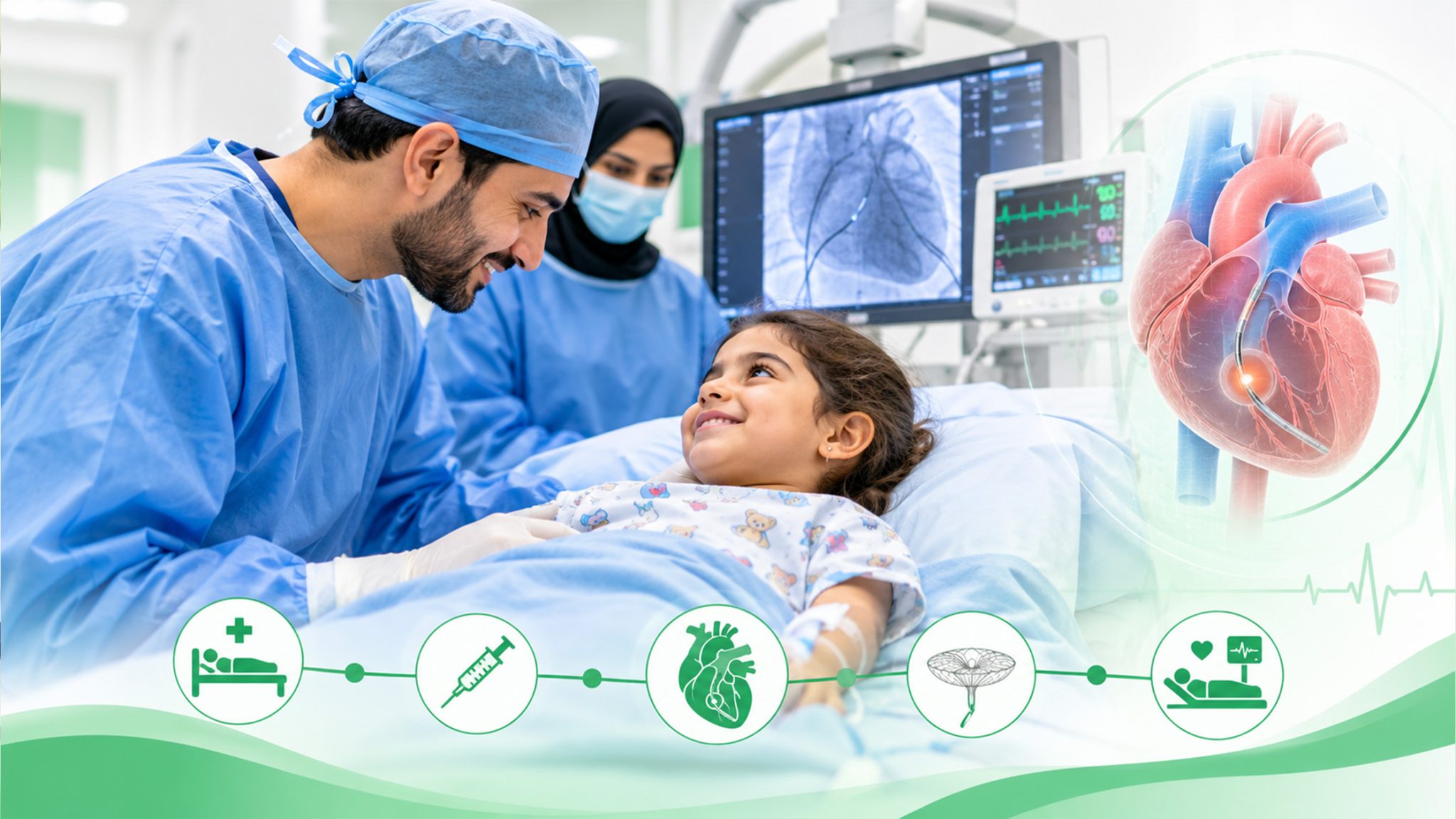
Most of what parents fear about a cardiac catheterization comes from not knowing how the day unfolds. So here it is in order, from the evening before to the week after, the way it usually runs for a child seen by KidsHeart’s Pediatric Cardiology team in Dubai Healthcare City. Times vary by hospital and by child. The sequence rarely does.
The evening before
Dinner should be an ordinary one, finished early. Most children are asked to stop solid food at midnight and clear fluids a few hours before arrival, because nearly every pediatric catheterization is done under general anesthesia or deep sedation. An early report from the US-based IMPACT Registry, published in Cardiology in the Young, found anesthesia was used in roughly 85 percent of procedures.
Pack tonight, not at 5 a.m.:
- Loose trousers or shorts, since a dressing will sit at the top of the leg
- A favorite blanket or soft toy
- A drink and a light snack for after the anesthetist gives the all-clear
- Regular medicines, in their original boxes
- The latest echo report and a written list of questions
- A fully charged phone
Children over four or five usually cope better with a short, honest explanation the night before than with a long one on the morning. The ideas for preparing for heart tests work just as well here: a small number of true sentences, said calmly, and room for the child’s own questions. Something as simple as “Tomorrow you’ll have a long sleep, and while you sleep the doctor will look at your heart with a tiny tube. When you wake up, your leg will have a plaster and you’ll need to lie still for a while” covers most of what a young child needs.
6:30 a.m.: check-in
A nurse records weight, temperature, blood pressure, and oxygen levels. A child with a cough or fever may be sent home and rebooked, which is frustrating and also correct. Anesthesia on a child with a fresh chest infection carries more risk than a week’s delay.
Then the anesthetist arrives. Expect questions about allergies, loose teeth, snoring, and previous reactions to anesthesia. Some children breathe a gas through a mask while sitting on a parent’s lap. Others have a small cannula placed in the hand first, with numbing cream to take the sting out. In many hospitals a parent can stay until the child is asleep.
The cardiologist usually stops by as well, to go through the consent form. This is the moment to ask the questions that matter most. Is this procedure diagnostic, interventional, or both? What happens if the catheter approach does not work on the day? Where exactly will the procedure take place? Outpatient visits in Dubai Healthcare City and the catheterization lab are not always in the same building.
8:00 a.m.: inside the lab
Once the child is asleep, the cardiologist places a thin, flexible tube, roughly as thick as a strand of spaghetti in a young child, into a blood vessel. The groin is the usual entry point. Sometimes it is the neck or arm. The catheter is steered up into the heart under live X-ray. There is no chest incision, and the heart keeps beating throughout.
In a diagnostic study, the catheter measures pressures and oxygen levels inside each chamber and takes detailed pictures using contrast dye. Better imaging, including cardiac MRI, now answers many of those questions without a catheter at all, which is why most catheterizations today are done to fix something. The IMPACT Registry report found that only about 35 percent of nearly 20,000 procedures were diagnostic alone.
The fixing can take several forms:
A folding device closes a hole between the upper chambers. A coil or plug seals a patent ductus arteriosus (PDA). A balloon stretches a narrow valve open, called balloon valvuloplasty. A narrowed aorta or pulmonary artery is widened, sometimes with a stent. In older children and teenagers, a new pulmonary valve can be placed through the catheter.
Seattle Children’s Hospital notes that children treated this way instead of with open surgery have less pain, recover faster, and often go home the same day or the next morning. Not every defect suits a catheter. Position and shape decide it, which is explained in more detail in the post on ASD in children.
10:30 a.m.: the conversation in the corridor
A simple diagnostic study may take about an hour. A device closure or valve procedure can run two to four. Most teams send word partway through. Eat something while you wait, even if you are not hungry. The afternoon ahead is long, and a parent running on no food and no sleep finds the lying-flat hours much harder.
When the cardiologist comes out, the news is usually good, and parents tend to remember the relief and very little else. Write down what you are told. If two parents are there, one can listen while the other writes. If only one parent is there, ask whether the cardiologist can repeat the key numbers at discharge. The size of the device, the pressure before and after, whether a small leak remains. These are the numbers every future doctor will ask for, and they are much harder to recover from memory three months later.
This is also when the cardiologist will mention anything unexpected. Complications are uncommon, and most of them are small: bruising at the entry site, a brief irregular heartbeat while the catheter moved, a temporary drop in the pulse of the leg. Less often a device shifts after placement, a vessel is injured, or a reaction to the dye or anesthesia occurs. Very young babies and children with complex hearts carry more risk than an older child having a simple closure, and the consent conversation earlier in the morning should already have given you a sense of where your child sits on that range.
Midday: the first sip of water
Waking from anesthesia is rarely as tidy as parents picture. A sore throat is common if a breathing tube was used. Some children feel sick, and a few vomit once or twice. Most are allowed small sips of water within an hour or so, then a light snack if that stays down. Pushing a full meal too early tends to end badly, so the snack you packed the night before earns its place here.
Expect a monitor lead on a finger or toe, a cannula still in the hand, and a pressure dressing at the top of the leg. Children often mind the cannula far more than the wound. It usually comes out before discharge.
At the Dubai Healthcare City clinic, families are often told who to call if anything worries them overnight. If no one has said, ask before you leave the ward.
Afternoon: lying flat
This is the hardest stretch for many families.
The child usually has to lie flat for four to six hours so the small puncture in the vessel can seal. Nurses check the dressing, the pulse in the foot, and the warmth and color of the leg at regular intervals. Some children wake groggy and sleep for hours. Others wake upset, thirsty, and determined to climb off the bed, which is exactly what the leg cannot do yet. A tablet, an audiobook, or a parent lying alongside helps more than anything the ward can offer.
Before discharge, the team usually repeats an echocardiogram and sometimes an ECG or chest X-ray to confirm that any device is sitting where it should. Many children go home that evening. Others stay one night.
The next seven days
The small wound needs a clean, dry dressing for a day or two. No baths, swimming, or rough play for about a week. A small bruise is normal. A lump that keeps growing, bleeding that soaks through a dressing, a cold or pale foot, or a fever in the following days are reasons to call the cardiology team the same day.
Children who received a closure device are often prescribed low-dose aspirin for several months. They also need antibiotics before certain dental work during the first six months, while the lining of the heart grows over the device. Make sure the discharge sheet says so in writing.
Most children are back at school within two or three days, with physical education skipped for about a week. A short note from the cardiologist saves an awkward conversation with the PE teacher.
Follow-up scans usually fall at around one month, six months, and a year. Families living in Abu Dhabi or Al Ain can often have these done at KidsHeart’s branches there, rather than driving back to Dubai for every check.
Six months on
The six-month echo is the one families tend to remember. For a child with a closure device, it usually confirms that the heart lining has covered the device fully and that no leak remains. That visit is often when aspirin stops and when the six-month window for dental antibiotics closes. Ask the cardiologist to confirm both out loud and write the dates down.
If the date has not been set yet, there is still time to book a cardiology consultation and walk through this day with the cardiologist first.